Guide
FOB vs CIF vs DDP:
shipping terms for clothing orders explained
Factories usually quote FOB. A first-time buyer then has to work out what still needs paying before the goods reach their warehouse.
This page explains EXW, FOB, CIF, DAP and DDP in plain words: who arranges, who pays and where risk passes. It also shows how to compare quotes on different terms.
It gives no duty rates. Those come from official customs sources. For when money changes hands, read payment terms explained.
What FOB, CIF and DDP mean on a clothing quote
These codes are Incoterms® rules, published by the International Chamber of Commerce. The current edition is Incoterms 2020. A quote should name the edition.
A term is always paired with a named place, for example "FOB [port of loading]" or "DDP [your warehouse]". Without the place, the term is incomplete.
A term decides four things:
- who arranges and pays for main freight
- who pays for insurance
- who clears export and import, and who pays duty
- where risk of loss or damage passes from seller to buyer
A term does not decide when you pay, who owns the goods or what the garments cost. Payment timing is a separate agreement. See payment terms explained.
This page covers garment orders shipped from a factory overseas to a brand in the UK or US.
EXW vs FOB vs CIF vs DAP vs DDP: who pays for what
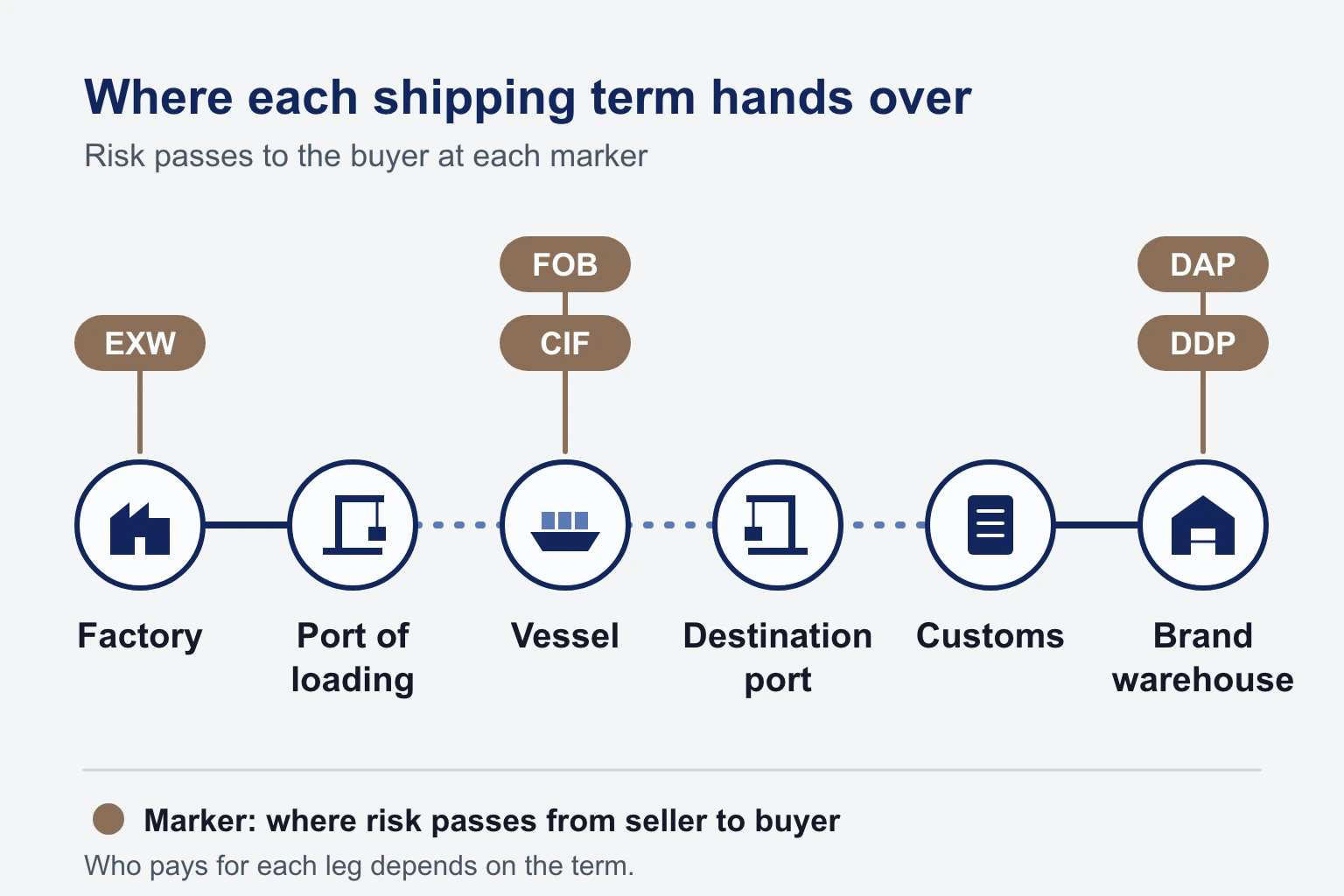
The diagram shows who handles each step under each term. The list below says the same in words, from most buyer work to most seller work.
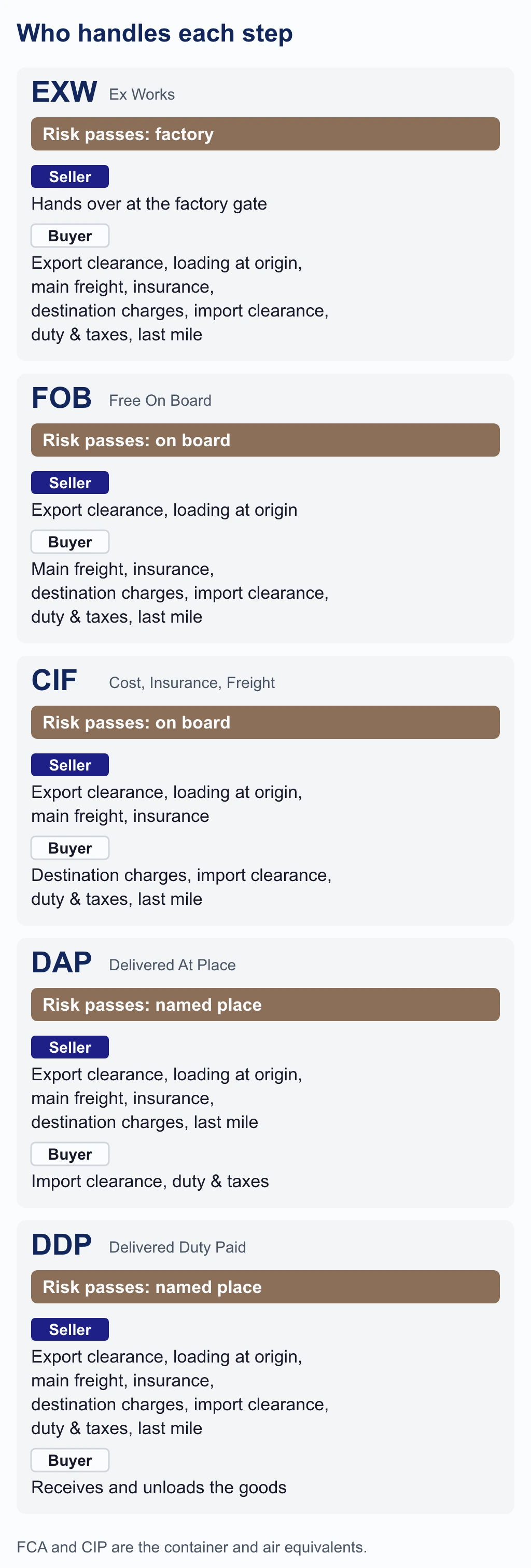
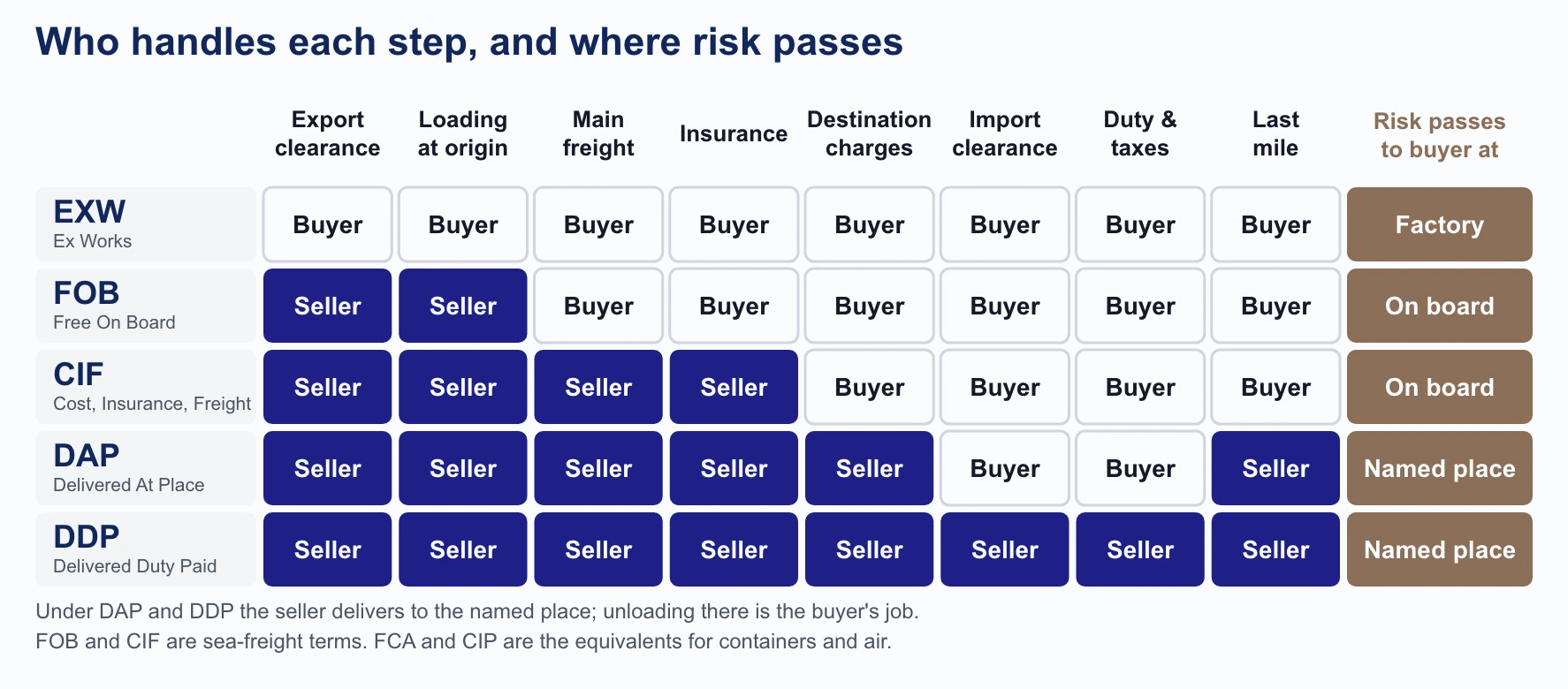
- EXW (Ex Works): you collect the goods at the factory. You arrange main freight, do export clearance, and pay insurance, import clearance and duty. Risk passes at the factory. Most work and risk sits with the buyer.
- FOB (Free On Board): the seller clears export and loads the goods onto your nominated vessel at the port of loading. You book and pay ocean freight, insurance, import clearance, duty and delivery. Risk passes once the goods are on board.
- CIF (Cost, Insurance and Freight): the seller also pays ocean freight and minimum insurance to the destination port. Risk still passes on board at origin, the same point as FOB. You pay destination charges, import clearance, duty and delivery.
- DAP (Delivered At Place): the seller delivers to a named place in your country, ready for unloading. You clear imports and pay duty and taxes. Risk passes at the named place.
- DDP (Delivered Duty Paid): the seller delivers to the named place, clears import and pays duty and import taxes. Risk passes at the named place. Most work and risk sits with the seller. You receive and unload.
FOB and CIF are sea-freight terms. For containerised or air shipments, the ICC's equivalents are FCA and CIP, so a quote may use those instead.
FOB or DDP: control or convenience
For a first order, the real choice is usually between FOB with your own forwarder and a delivered price (DDP). Neither is cheaper by default. Compare them on landed cost. How to compare quotes shows how.

FOB
The price covers the goods loaded onto the vessel at the port of loading.
You arrange
- A freight forwarder
- Freight booking
- Cargo insurance
- A customs broker
- Delivery to your warehouse


Good for
- Brands that want to choose the carrier
- Seeing each cost line
- Consolidating with other suppliers
Watch
- More moving parts on a first order
- You are the importer

DDP
The price covers delivery to your door, with duty paid.
Seller arranges
- Freight
- Insurance
- Import clearance
- Duty and import taxes
Good for
- First orders
- Small brands without a forwarder
Watch
- Duty and freight are folded into one price, so you see less
- Check who is the importer of record
- Check what is excluded, such as unloading, storage or re-delivery
- Not every factory offers it
FOB vs CIF: why does a CIF quote look higher but not cover more risk?
CIF adds ocean freight and minimum insurance to the price. But you still carry the risk from the moment the goods are on board at origin.
The insurance is basic cover, chosen by the seller. Many buyers prefer FOB, with their own forwarder and their own insurance.
Is DAP the same as DDP?
No. Under DAP you still clear customs and pay duty and import taxes when the goods arrive. Under DDP the seller does that for you.
When does EXW make sense?
Only when you have a forwarder with an export agent at origin. A first-time buyer usually finds FOB simpler, because the seller handles export clearance.
Why garment factories quote FOB, and what you add on top
Factories quote FOB because it covers what they control: production, export packing, export clearance and loading at the port of origin. Freight rates, duty and destination costs depend on your country, your carrier and your timing.
FOB also keeps the garment price comparable across buyers and lets you use your own forwarder.
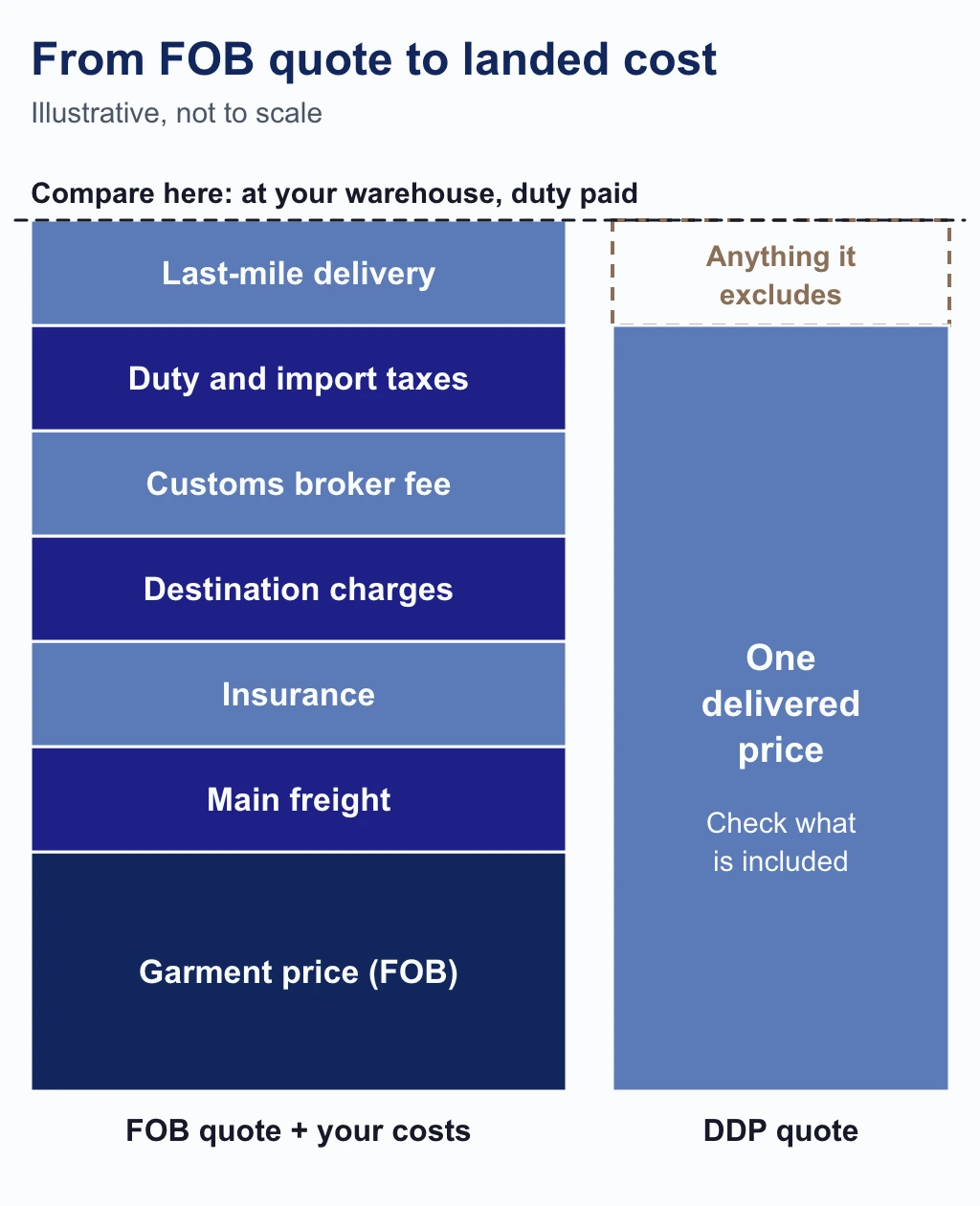
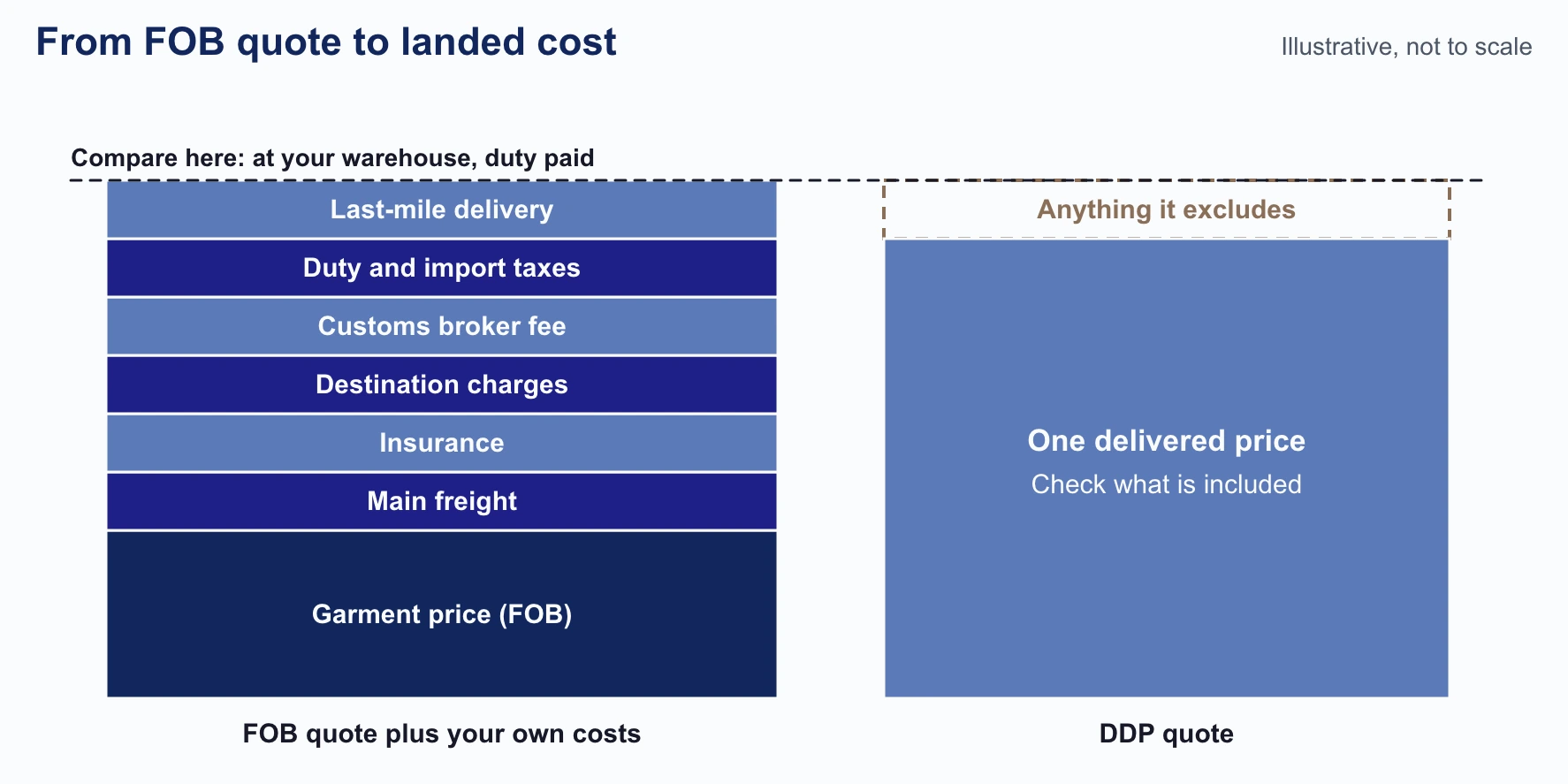
On top of an FOB price, you add:
- main freight, by sea or air
- cargo insurance
- destination port or terminal charges
- the customs broker fee
- duty and import VAT or sales tax
- last-mile delivery to your warehouse
The result is the landed cost per piece. That is the number to compare against your target price.
UK readers can find import basics in working with an overseas denim manufacturer from the UK.
How to compare two clothing quotes on different shipping terms
Bring both quotes to the same point, usually your warehouse with duty paid. Then compare them per piece.
Work through these steps for each quote:
- Confirm the terms. Check the Incoterm, the named place and the edition on each quote.
- Price the journey. Get a forwarder quote for freight, insurance, destination charges and broker fee, from the FOB or CIF point to your door.
- Estimate duty and import taxes. Use official sources or your broker. This page gives no rates.
- Add last-mile delivery. That is the leg from the port or terminal to your warehouse.
- Divide by quantity. The answer is landed cost per piece.
Check that both quotes assume the same quantity, packing, carton count and volume, currency and quote validity. A lower price on a different quantity or currency is not a lower price.
Here is a worked example, using letters instead of prices:
- Factory A, FOB: FOB price + freight + insurance + destination charges + broker fee + duty and taxes + delivery = landed cost A
- Factory B, DDP: DDP price + anything it excludes, such as unloading, storage or re-delivery = landed cost B
The better quote is the one with the lower landed cost per piece, not the lower headline price.
When you give a factory a target price, say which delivery term it assumes. Clothing manufacturers for startups has more on briefing a first order.
Freight forwarders and customs brokers: what they do
Under EXW, FOB, CIF and DAP, the buyer needs at least one of them.
What a freight forwarder does
A freight forwarder books space with carriers and arranges collection from the port or factory. They consolidate cargo and handle shipping documents. They can also arrange insurance and delivery to your door.
What a customs broker does
A customs broker files the import declaration and classifies the goods by commodity (HS) code. They calculate and pay duty and taxes on the importer's behalf, and handle customs queries.
Many forwarders offer brokerage too.
When you need one
Under EXW, FOB and CIF you need a forwarder or carrier at destination, and a broker. Under DAP you need a broker. Under DDP the seller's side handles both, but check who is the importer of record.
Get a forwarder quote before you accept an FOB price.
Do you need cargo insurance?
Risk passes to you at the point the term sets: on board for FOB and CIF. Carrier liability is limited, so many buyers insure their goods from that point. Under CIF the seller buys only minimum cover. Your forwarder can arrange insurance for you.
How shipping terms fit with payment terms
Shipping terms set who moves the goods and where risk passes. Payment terms set when money moves. You agree them separately, but they run on the same timeline.
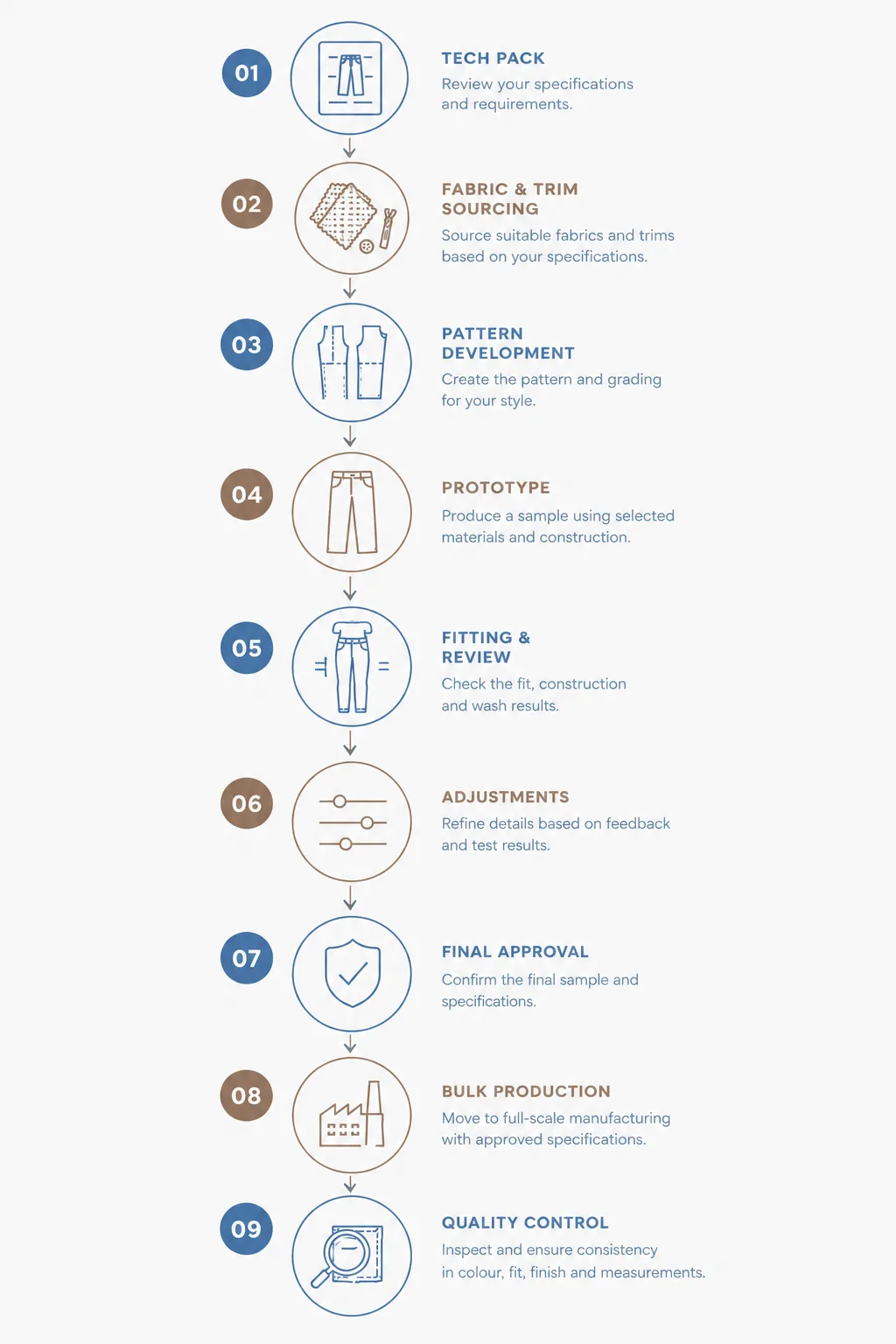
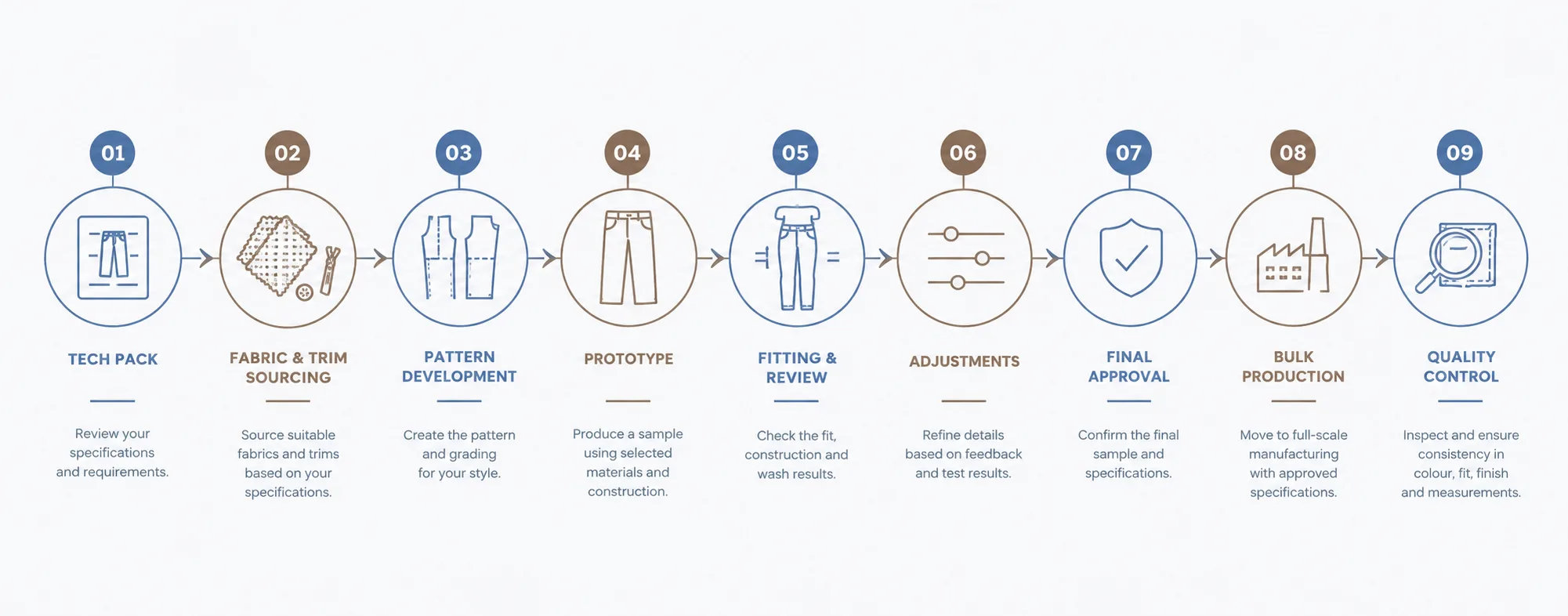
The diagram shows the production path from tech pack to quality control. Shipment under the agreed Incoterm starts after it.
On a new 30/70 T/T order, the balance is due before shipment. So you pay in full before the goods leave the factory. Under FOB or CIF, risk then passes once the goods are on board. Book your forwarder and insurance before the balance is due, so the shipment is not held up.
The pre-shipment inspection happens before the balance. See denim quality control and AQL.
For 30/70 T/T, open account and credit insurance, read payment terms explained.
Duty and import rules: use official sources
This guide gives no duty rates, thresholds or de minimis values. They change, and they depend on the product code, fibre content, origin and destination.
Duty is calculated from the importer's declaration. Country of origin usually follows where the garment is made, not where the fabric came from, but preferential-duty rules can differ, so confirm it with your broker. For Top Mondial's factories, see China vs Cambodia denim manufacturing.
For the UK, use gov.uk. For the US, use U.S. Customs and Border Protection. Ask your customs broker to confirm the commodity code before you order.
Under DDP the seller pays the duty, but it is still built into the price you pay.
Shipping terms with Top Mondial
For new customers, Top Mondial's typical structure is FOB, with a 30% deposit and the 70% balance paid before shipment. See payment terms explained.
We run three factories: one in Zhejiang, China and two in Cambodia. Our in-house warehouse handles order sorting, packing and shipment preparation. We ship to 20+ markets.
If you want a different term, such as EXW, CIF, DAP or DDP, ask. The quote confirms which Incoterm and named place apply to your order.
When you enquire, send:
- quantity by style, colour and wash
- your target price, and the Incoterm it assumes
- the destination city or port, and your delivery window
- whether you already have a forwarder
- a tech pack or reference garment
See our factories. Opening a new account with a factory? Read the company checklist for new factory accounts.