Guide
Jeans quality control inspection:
AQL, defects and testing explained
Quality control on a bulk jeans order means checking finished garments against the approved sample and tech pack, at set points in production, using an agreed sampling rule (AQL).
Denim needs extra attention because fabric lots, washing and hardware add defects that plain garments do not have.
This guide covers the three inspection stages, AQL in plain words with a worked example, a denim defect table, pre-shipment tests, third-party vs factory QC, and a checklist for the order.
What does quality control cover on a bulk jeans order?
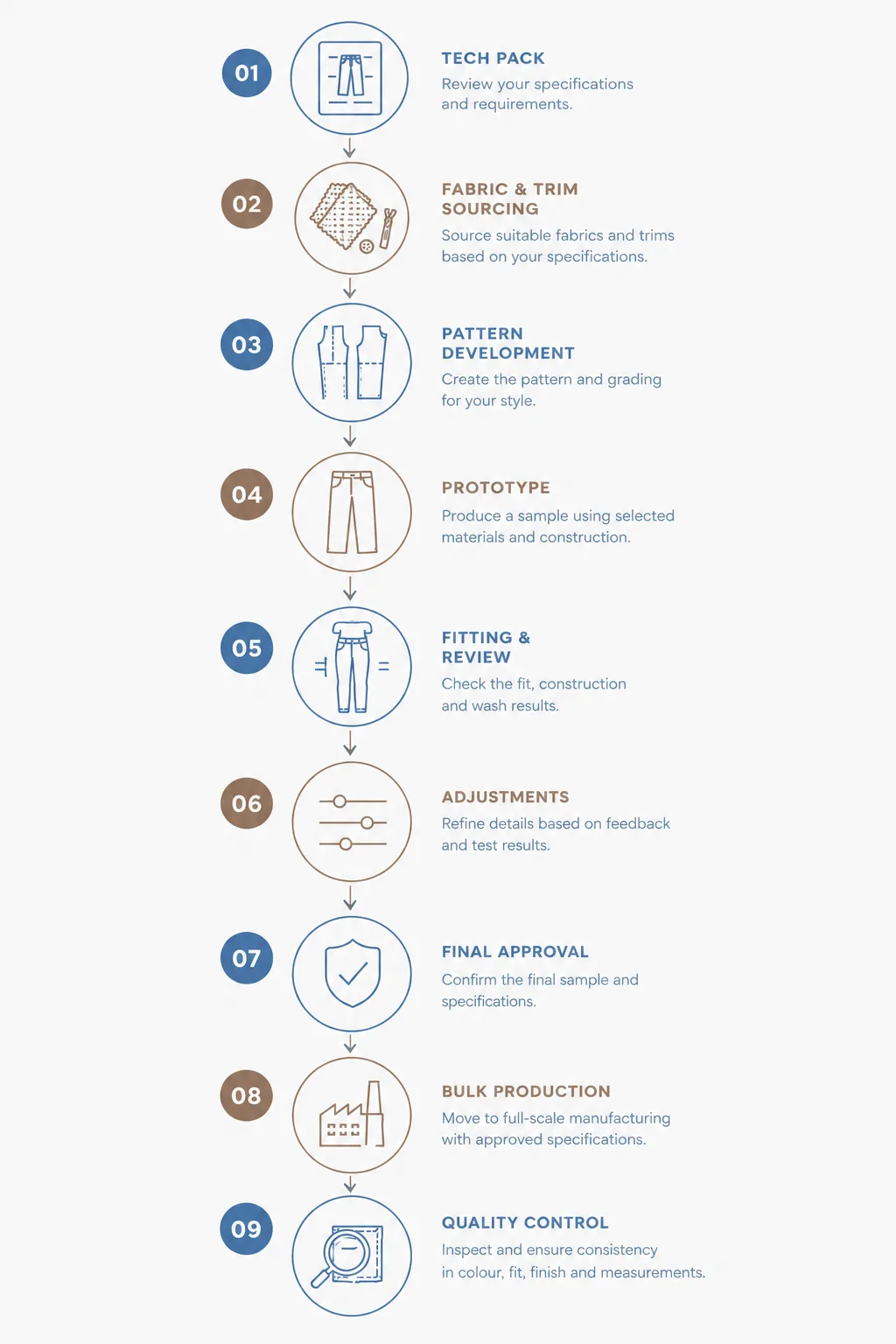
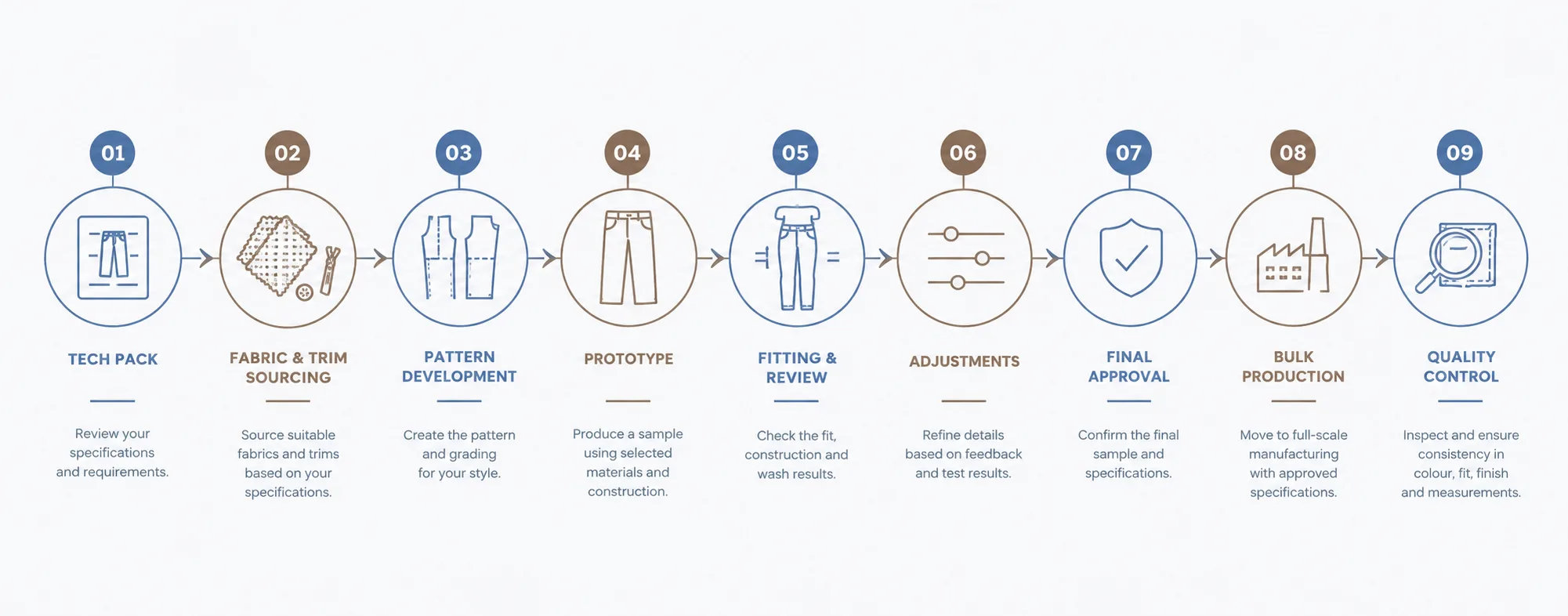
Quality control (QC) is the last of the nine steps in the diagram below. On a bulk jeans order, it means checking finished goods against two references: the approved sample and the tech pack. Denim sampling explained shows how the approved sample is set.
On finished jeans, QC checks:
- Measurements against the tolerances in the tech pack
- Shade
- Stitching and seam construction
- Wash consistency
- Defects, such as hardware faults and marks
Two terms need separating. Inspection is a visual and measurement check on a sample of finished garments. Testing is a lab method run on fabric or garments, such as shrinkage, colour fastness or seam strength. Inspection shows whether the goods match the sample. Testing shows whether the fabric and seams hold up.
Fabric is checked before cutting, because lots can vary in shade and shrinkage. This page focuses on garment inspection and testing. To see where QC sits in the whole process, read how jeans are made.
Inline, pre-final and final inspection: what is checked at each stage
Three inspections run at three points in production. The earlier a problem is found, the cheaper it is to fix.
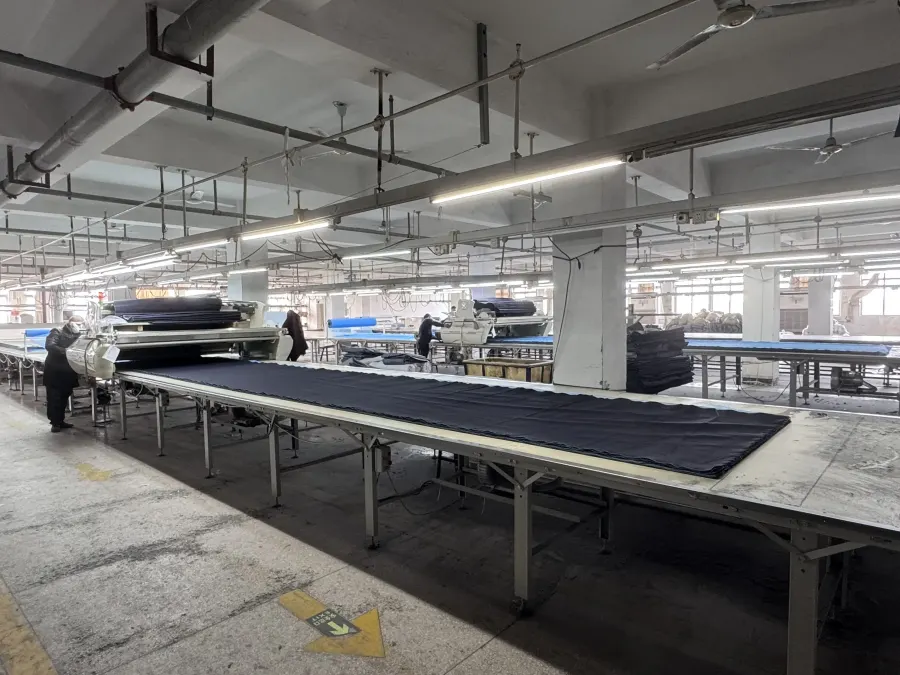
1. Inline inspection (during production)
Inline inspection runs while cutting, sewing and washing are under way. It starts with the first output off the line.
It checks stitch consistency, seam construction, measurements on early pieces and the first wash results against the approved wash standard. The measurements and tolerances come from your tech pack.
The aim is to catch a systematic fault before it repeats across the whole order.
- First-output check
- Stitching and construction
- Early measurements
- First wash against the standard

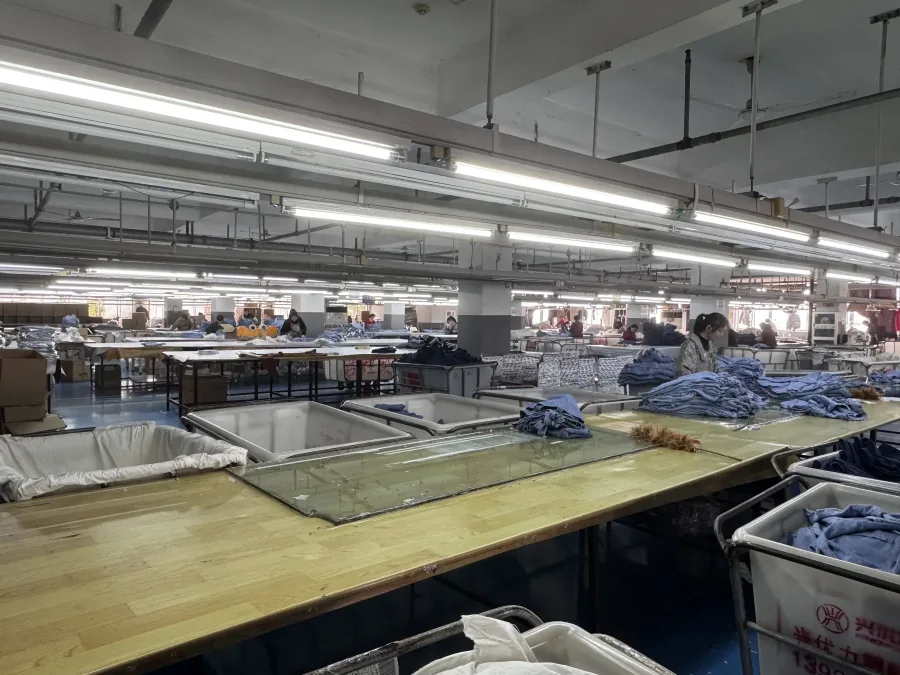
2. Pre-final inspection (partway through production)
Pre-final inspection runs on finished, washed garments once part of the order is complete. Common practice is to run it at that point, but it is not a fixed rule. Some inspectors call it a during-production inspection (DUPRO).
It checks measurements across the size range, shade within and between lots, wash consistency, hardware attachment and workmanship.
The aim is to leave time to rework or correct before the shipment date.
- Full size-range measurements
- Shade and wash consistency
- Hardware attachment
- Time left to correct
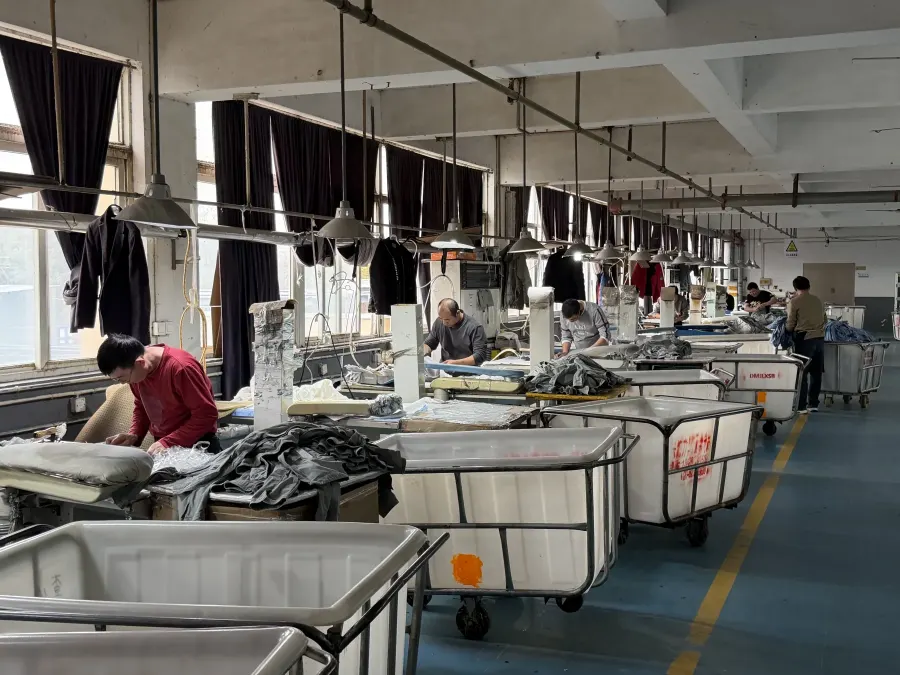
3. Final inspection (before shipment)
Final inspection is also called final random inspection or pre-shipment inspection. Common practice is to run it when 100% of the order is produced and at least 80% is packed.
Cartons are drawn at random, and garments are sampled to the agreed AQL. It covers everything in the pre-final check, plus packing, labels, hangtags, carton marks and quantity.
The result is pass or fail against the AQL. The next section explains what that means.
- Random carton draw
- AQL sampling
- Packing and labelling
- Quantity count
What is AQL? Acceptance quality limit in plain words
AQL stands for acceptance quality limit. It comes from ISO 2859-1. The US equivalent is ANSI/ASQ Z1.4.
It is a sampling rule. You inspect a set number of garments from the lot. You then accept or reject the whole lot based on how many defects you find. You do not inspect every pair.
In plain words, AQL 2.5 means the buyer accepts lots whose defect rate is, on average, no worse than 2.5%. It does not guarantee that a lot has 2.5% or fewer defective pieces. A single lot can be better or worse than that.
Three inputs set the plan:
- Lot size: the number of pairs in the order, or the part of it being inspected
- Inspection level: General Level II is the normal default
- AQL value: set separately for each defect class
The standard's tables turn these into a sample size and an accept/reject number.
Defects are sorted into three classes:
- Critical: unsafe or illegal, for example a sharp broken rivet or a needle fragment
- Major: likely to be returned or unsellable, for example a broken zip or an off-shade panel
- Minor: a small flaw that is unlikely to cause a return, for example an untrimmed thread end
A lower AQL is stricter. Each class gets its own AQL.
AQL worked example: inspecting 2,000 pairs of jeans
This is how AQL works for a lot of 2,000 pairs. The values come from the ISO 2859-1 single-sampling table for normal inspection. The diagram shows them in one place.
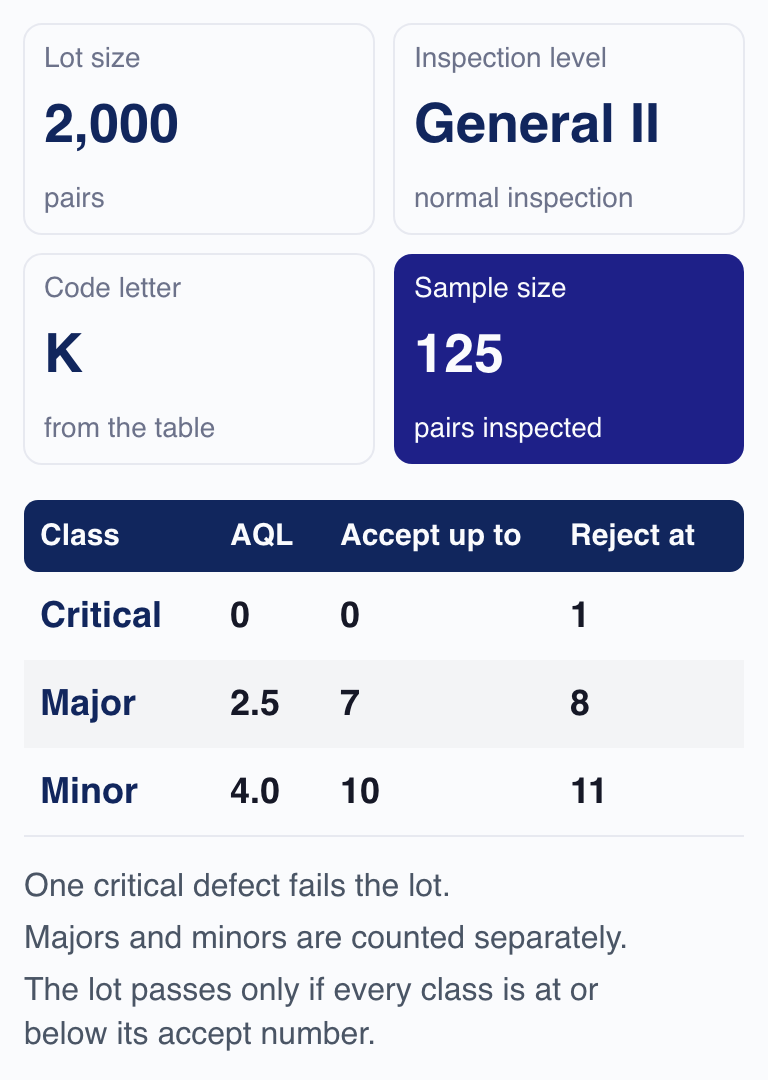
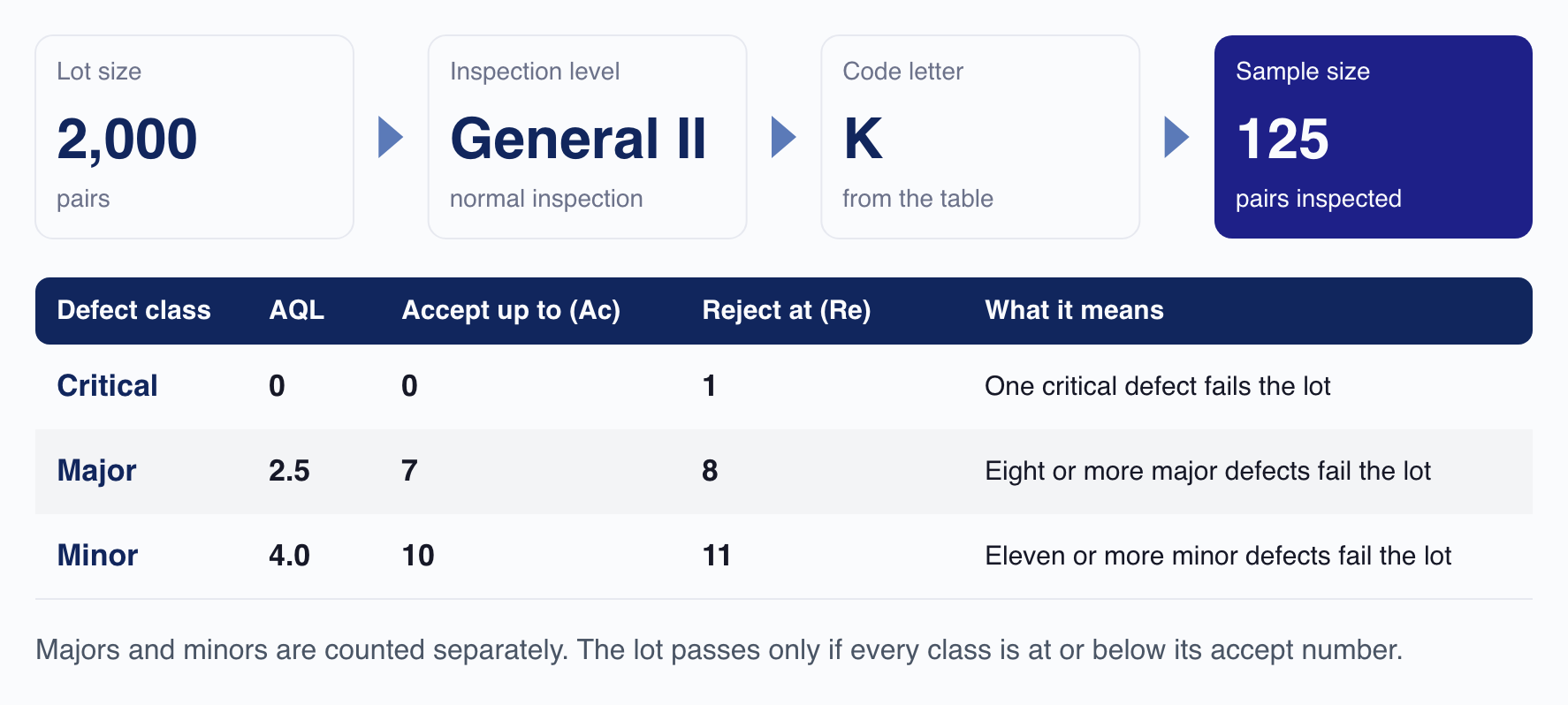
- Lot size: 2,000 pairs
- Inspection level: General II. This gives sample size code letter K and a sample size of 125 pairs.
- Critical defects, AQL 0: accept 0. One critical defect fails the lot.
- Major defects, AQL 2.5: accept up to 7, reject at 8.
- Minor defects, AQL 4.0: accept up to 10, reject at 11.
Majors and minors are counted separately. The lot passes only if every class is within its accept number. If the lot fails, the usual route is to sort and rework it, then re-inspect. Agree in the order who pays for re-inspection.
Now a smaller lot. Top Mondial's minimum order is 500 pieces. A 500-piece lot at General II gives code letter H and a sample of 50 pieces. Major AQL 2.5 is accept 3, reject 4. Minor AQL 4.0 is accept 5, reject 6. Critical stays at accept 0.
The sample size grows much more slowly than the lot. The 2,000-pair lot is four times the size of the 500-piece lot, but its sample is only 2.5 times as large (125 against 50). That is why AQL is practical for bulk orders.
How to set AQL levels for a jeans order
Agree AQL levels before production starts, not at the inspection.
Classify defects first
Write your own critical, major and minor list for jeans. A defect in a visible zone, such as the front panel, waistband or fly, is usually classed higher than the same defect hidden inside.
Common starting levels
In apparel, critical 0, major 2.5 and minor 4.0 is a widely used starting point. That is common practice, not a rule.
When to tighten
Tighten the levels for premium or retail programmes, a first order with a new factory, or a style that failed before. For example, major 1.5 and minor 2.5.
A stricter AQL means more risk of failing and reworking. Agree it up front.
Inspection level
General Level II is the default. Level III gives bigger samples for higher risk.
Special levels S-1 to S-4 use small samples. They suit slow checks such as full measurement or destructive tests.
Put it in writing
The AQL values, inspection level and defect list belong in the purchase order or quality agreement. The checklist below shows what to include.
Common denim defects and how inspectors check them
Denim has defects that come from fabric, washing and hardware, not only sewing. The table below lists the main ones, what causes them and how they are checked. It gives no defect rates, because these vary from order to order.
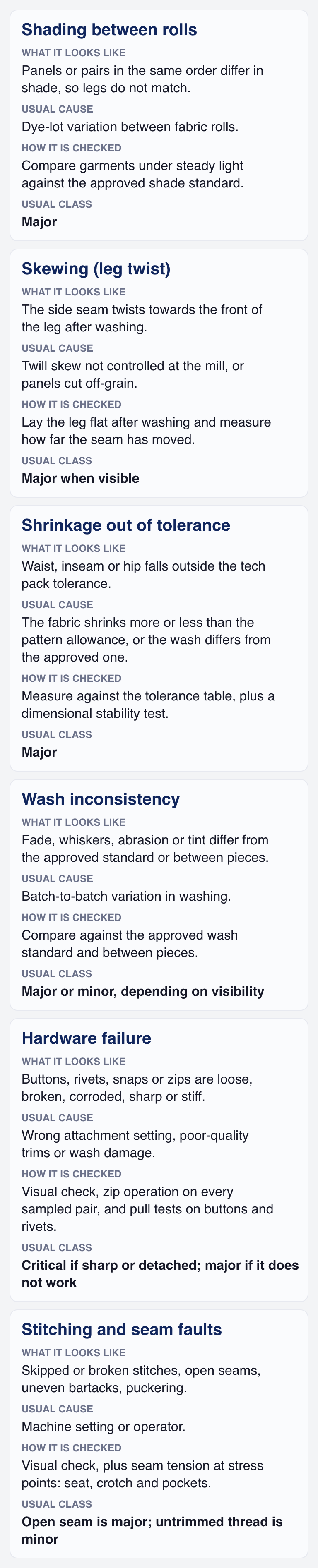
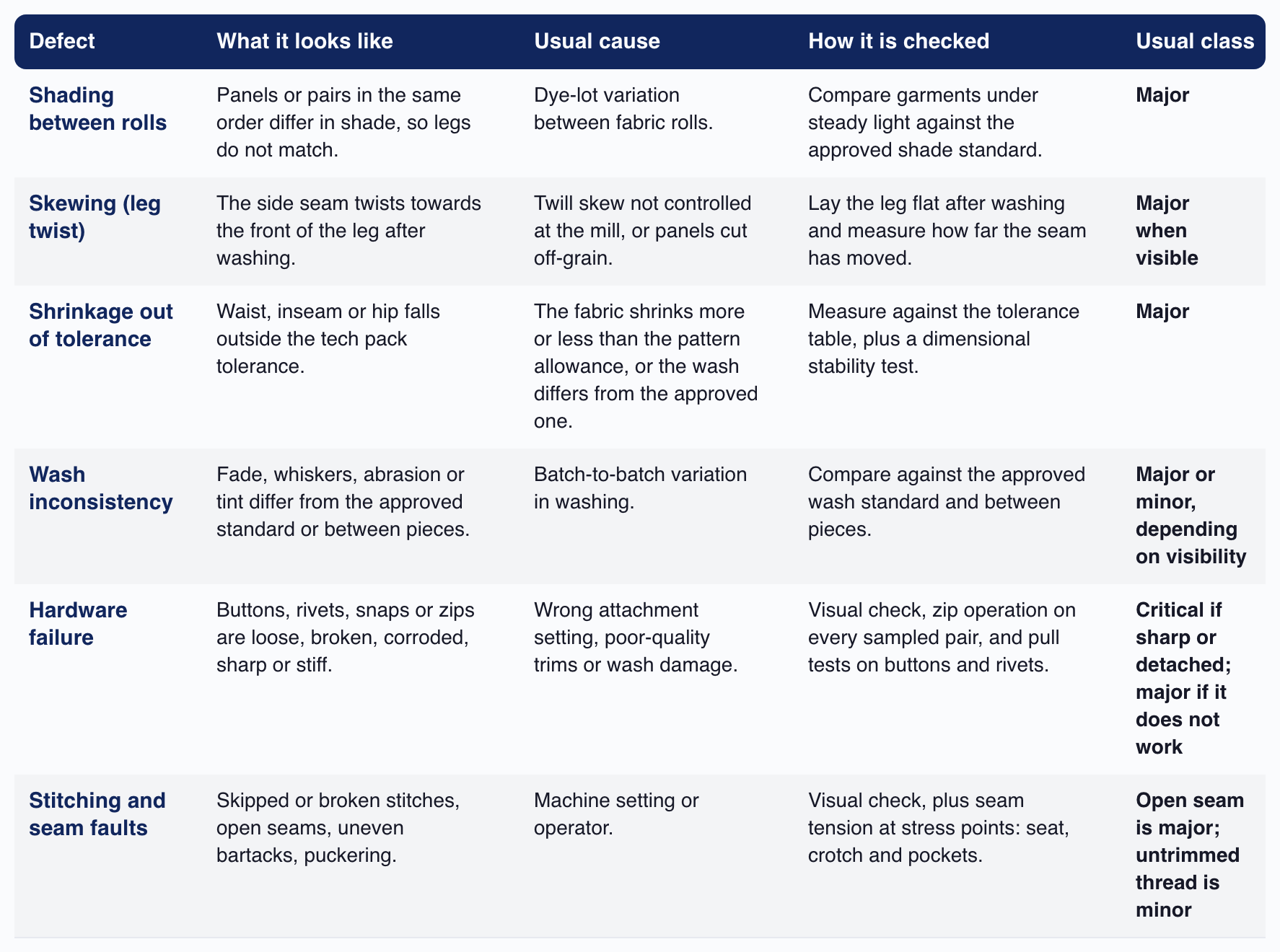
Shading between rolls
- What it looks like: Panels or pairs in the same order differ in shade, so legs do not match.
- Usual cause: Dye-lot variation between fabric rolls.
- How it is checked: Compare garments under steady light against the approved shade standard.
- Usual class: Major
To prevent it, rolls are shade-sorted and cutting is kept within a lot.
Skewing (leg twist)
- What it looks like: The side seam twists towards the front of the leg after washing.
- Usual cause: Twill skew not controlled at the mill, or panels cut off-grain.
- How it is checked: Lay the leg flat after washing and measure how far the seam has moved.
- Usual class: Major when visible
Shrinkage out of tolerance
- What it looks like: Waist, inseam or hip falls outside the tech pack tolerance.
- Usual cause: The fabric shrinks more or less than the pattern allowance, or the wash differs from the approved one.
- How it is checked: Measure against the tolerance table, plus a dimensional stability test.
- Usual class: Major
For how shrinkage and recovery are set, see denim fabric weights.
Wash inconsistency
- What it looks like: Fade, whiskers, abrasion or tint differ from the approved standard or between pieces.
- Usual cause: Batch-to-batch variation in washing.
- How it is checked: Compare against the approved wash standard and between pieces.
- Usual class: Major or minor, depending on visibility
The wash standard is set at sampling. See custom denim washes.
Hardware failure
- What it looks like: Buttons, rivets, snaps or zips are loose, broken, corroded, sharp or stiff.
- Usual cause: Wrong attachment setting, poor-quality trims or wash damage.
- How it is checked: Visual check, zip operation on every sampled pair, and pull tests on buttons and rivets.
- Usual class: Critical if sharp or detached; major if it does not work
Stitching and seam faults
- What it looks like: Skipped or broken stitches, open seams, uneven bartacks, puckering.
- Usual cause: Machine setting or operator.
- How it is checked: Visual check, plus seam tension at stress points: seat, crotch and pockets.
- Usual class: Open seam is major; untrimmed thread is minor
Pre-shipment testing for jeans: shrinkage, colour fastness and seam strength
Testing is separate from AQL inspection. Lab methods are run on fabric or sample garments, by the mill, the factory or an independent lab, as agreed in the order.
- Dimensional stability (shrinkage): mark and measure a garment or fabric panel. Wash and dry it under a set procedure, then measure it again and express the change as a percentage. Common methods are ISO 6330 washing with ISO 5077 measurement, or AATCC 135 and 150.
- Colour fastness to rubbing (crocking): rub the fabric with dry and wet white cloth, then grade the staining on a grey scale. Methods include ISO 105-X12 and AATCC 8. This matters for indigo, which can transfer to furniture and lighter garments.
- Colour fastness to washing: checks for colour loss and staining. ISO 105-C06 is a common method.
- Seam strength: pull a seam apart on a tensile tester and record the force at which it fails or opens. Methods include ISO 13935-2 and ASTM D1683. The key seams are the seat, inseam and crotch.
- Hardware tests: pull tests on buttons, rivets and snaps check that the attachment holds. Children's jeans usually have stricter requirements.
The buyer sets the method and pass level in the order. This guide gives no results or pass marks. Results come from the test report for each order.
For why denim shrinks and how to write shrinkage and stretch limits into your tech pack, see denim shrinkage and stretch recovery.
Third-party inspection vs factory QC: which do you need?
They are complementary, not alternatives. Factory QC controls quality during production. A third-party inspector gives you an independent pass or fail at set points, usually the final inspection. The buyer normally books and pays for the third-party inspector.

Factory QC
The factory's own QC team checks continuously through production.
what it covers
- Inline checks on every line
- Pre-final and final checks against the approved sample
- Fixes on the spot
limits
- The factory is checking its own work
- You see reports rather than the goods

Third-party inspection
An independent inspection company, sent by the buyer, checks to the buyer's AQL and checklist.
when to use it
- A first order with a factory
- High-value or retail programmes
- A retailer that requires it
- No buyer staff on site
limits
- It checks a sample at fixed points
- It cannot fix problems during production
- It must be booked around the production schedule
What to put in your order: a jeans QC checklist
Copy this list into your purchase order or quality agreement. It gives the factory and the inspector the same rules to work to.
- Approved sample reference and approved wash and shade standard
- Tech pack measurement chart with tolerances
- Defect list classified as critical, major and minor
- AQL value per class and inspection level (for example General II; critical 0, major 2.5, minor 4.0)
- Which inspections you need (inline, pre-final, final) and who performs each, the factory or a third party
- Required tests with methods (shrinkage, colour fastness to rubbing and washing, seam strength, hardware pull) and who supplies the reports
- Packing, labelling and carton-marking requirements, checked at final inspection
- What happens on a fail: rework, re-inspection and who pays
QC standards are one of the things to review when you pick a factory. See how to choose a denim manufacturer.
If a retailer has compliance requirements, read denim factory certifications. A certificate such as ISO 9001 shows a quality system. It does not show the quality of your order.
Quality control at Top Mondial
Top Mondial runs a multi-stage quality control system, from development to delivery. The same QC runs in our plant in Zhejiang, China and in our two plants in Cambodia. The factories page shows the sites.
In practice:
- Approved sample specs are locked into the tech pack
- Fabric lots are checked before cutting, and cutting is kept within a lot
- Wash results are compared against the approved standard
- Multi-stage inline and end-of-line inspections run during production
- An inline QC team runs regular checks throughout production
- Each order gets a final audit before dispatch, against the approved sample
- Customer-specific quality and packaging requirements are followed
- Audits are standardised across OEM and ODM production
- Defects are tracked, and processes are improved over time
Third-party inspection and compliance support is available if you want an independent check.
We hold ISO 9001:2015, which shows that a quality management system is in place. It does not guarantee the quality of your order. Denim factory certifications explains what it does and does not prove.
Send your tech pack, AQL levels and test requirements with your enquiry.