Guide
Jeans rivets, hardware and trims:
a branding guide for denim brands
Hardware and trims are the parts of a pair of jeans that carry your brand: rivets, buttons, zips, the back patch, labels, hangtags and packaging. Without them the jeans are plain denim.
This guide covers each trim, the material and finish options, what custom branding involves, how custom trims affect lead time and minimums, and how trims react to washing. It ends with what to write in the hardware and trims section of your tech pack.
What are the hardware and trims on a pair of jeans?
Trims are every component that is not the denim itself. There are three groups: metal hardware (rivets and burrs, shank buttons and zips), branding (the back patch, labels and embroidery), and finishing and retail items (hangtags, pocket bags, pocket flashers and packaging).
Some trims do a job and carry branding at the same time. Rivets reinforce pocket corners. The shank button closes the fly. Both can carry your logo.
Each trim is chosen by six attributes: material, finish, size, colour, placement and artwork. The same six repeat through this guide and in the tech pack section at the end.
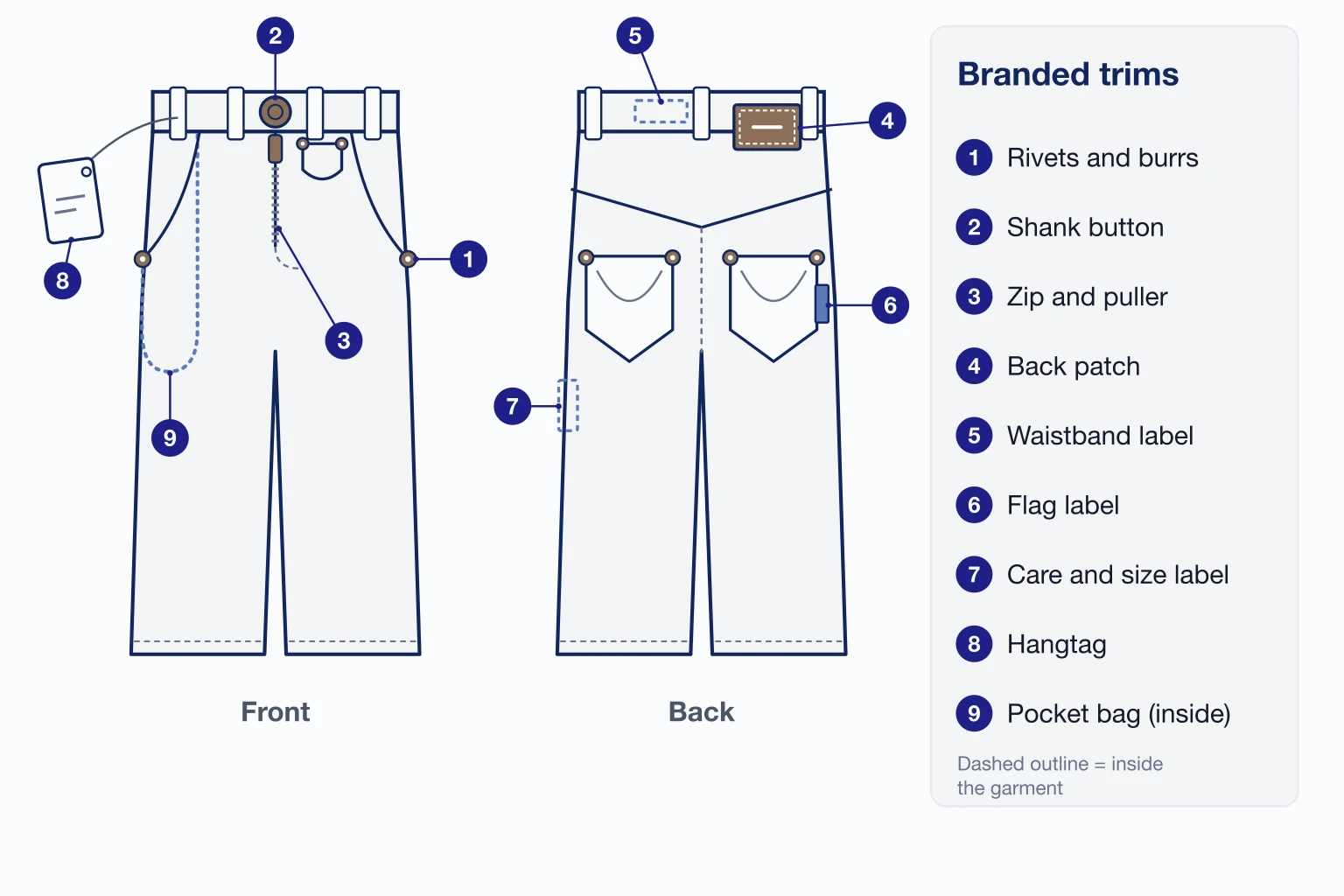
Here is where each trim sits on the garment:
- Front pocket corners: rivets and burrs
- Fly and waistband: the zip, with the shank button at the top
- Back waistband: the back patch and the woven waistband label
- Back pocket: the flag label and rivets
- Side seam: care and size labels
- Coin pocket: small rivets
Jeans rivets and hardware: rivets, burrs, shank buttons and zips
Metal hardware is the most visible branded trim, and the one that washing affects most.
Rivets and burrs
A rivet is a metal cap fixed through the fabric onto a back piece called the burr. Rivets sit at stress points, such as the front pocket corners and the coin pocket.
Their first job is reinforcement. Decoration comes second. The cap can be plain, embossed with your logo or engraved. The burr is usually plain.
Shank buttons
The shank button is the main waistband button. It is fixed with a pin, called a tack, through the fabric. It is not sewn on.
The face can carry your brand name or logo. The back of the tack can be marked too. A custom jeans button sits at the centre of the waistband, so the logo is easy to see.
Zips
The zip closes the fly. Metal teeth are standard on jeans. The puller, also called the slider tab, is the part that can be branded.
Choose the zip length to suit the rise. Ask for a locking slider so the fly stays up.
Materials and finishes
Common bases are brass, copper, zinc alloy, steel and aluminium. Finishes include antique brass, copper, silver, gunmetal, matte black and nickel-free.
Ask that the finish meets the chemical rules of the markets you sell in. Keep the same finish across the rivets, the button and the zip puller, so the set looks matched.
Custom engraving or embossing
Your logo is cut into a new die or mould. You supply vector artwork and approve a hardware sample before bulk.
Engraving and embossing read differently on small faces. Keep the mark simple.
Jeans back patches: leather, jacron and PU
The back patch is the label sewn on the back waistband, above the right back pocket. From behind, it is the most visible branding on the garment. There are three common materials:
- Leather: a premium look and hand feel. It darkens and softens with wear, and it can shrink or stiffen in washing. The washing section below has the detail.
- Jacron (paper): a heavy, washable paper-based board. It is the classic workwear patch. It costs less, takes print and deboss well, and softens and creases with wear.
- PU (polyurethane): an imitation leather. It gives a leather look without leather, with more consistent colour. It suits vegan positioning. It ages less naturally.
Debossed or printed? Debossing, including hot-stamping, presses the logo into the surface. It suits leather and jacron. Printing adds colour and detail. It suits jacron and PU. A deboss ages with the patch. A print can fade or crack in heavy washes.
Specify the material, colour, thickness, size, method (deboss, print or both), artwork and stitch placement.
Labels for jeans: woven waistband, care, size and flag labels
Woven waistband label
This is the main brand label, inside the back waistband. Woven gives a sharper, more premium result than printed.
Specify the fold type, size and colours. Also say how it is sewn: on all four sides or at the ends only.
Care and content labels
These are usually printed on satin or nylon tape and sewn into the side seam.
You supply the care symbols and fibre content for each market you sell in. The factory does not decide legal wording.
Size labels
A size label shows waist and leg size. It is often a small woven or printed label, or a printed mark inside the waistband.
Give the size format (W/L, numeric or letter) for each market.
Flag and tab labels
A flag label is a small folded woven label sewn into the edge of a back pocket or the coin pocket, so it shows on the outside. It is a strong brand signal that costs little.
Say which pocket, which side and which seam.
Hangtags, pocket bags, pocket flashers and packaging
Hangtags
The hangtag is the card tag on the finished pair. You set the design, size and card stock. You also choose how it attaches (string, loop or safety pin) and where (belt loop or label).
Keep it off the patch so it does not mark leather.
Pocket bags
The pocket bag is the inside pocket lining. Pocketing can be printed with your logo, a pattern or a message. It can also be made in a contrasting fabric.
Customers see it every time they use the pocket.
Pocket flashers
A pocket flasher is a printed card or sticker on the back pocket, made for retail. It tells the shopper the fit, size and fabric story. It is removed before the jeans are worn.
Packaging
Packaging covers folding, polybags, retail-ready packing and carton marks, prepared to your requirements.
For how packaging fits the whole order, read private label jeans manufacturing.
Stock vs custom trims: what changes in lead time and minimums
Stock trims come from a supplier's existing range. They are finished or branded with your logo where possible. Custom trims are made from your design and need tooling or a new production run. A common route is custom branding on the most visible trims (the shank button, back patch and waistband label) and stock on the rest. When you compare factories, ask whether custom trims change the garment MOQ. Denim MOQ explained shows how MOQ is counted.

Stock trims
Picked from a supplier's range. Your brand shows through finish, colour or a simple logo mark.
What you get
- Standard shapes and sizes
- A choice of finishes and colours
- Faster to approve


Lead time
- Usually shorter, since no tooling or new run is needed
Minimums
- Usually lower, because the trim already exists

Custom trims
Made to your design: engraved or embossed hardware, debossed patches, custom woven labels and printed pocket bags.
What you get
- A fully branded garment
- Your logo on every trim
- Consistency across reorders once tooling exists
Lead time
- Longer, because new dies or moulds, artwork approval and a trim sample come before bulk
Minimums
- Trim suppliers often set their own minimum per design, which can sit above the garment order
How trims react to denim washing
Jeans are usually washed after sewing, so most trims go through the wash with the garment. Stone, enzyme, bleach and acid washes are harsh on trims. See custom denim washes for what each wash does.
- Corrosion and discolouration: some metal finishes darken, tarnish or rust in bleach or acid washes. Abrasion can also rub plating off. Choose a finish tested for your wash. Ask whether the hardware can be applied after washing, as the factory can add some hardware at that stage.
- Colour transfer: dyed leather patches and some printed labels can bleed onto the denim around them. Ask for colour-fast materials, or attach these trims after washing.
- Patch shrinkage: leather can shrink, harden or curl in hot or heavy washes. Jacron softens and wrinkles. PU is the most stable. Approve the patch on a washed sample, not an unwashed one.
- Labels and threads: check label colours and thread on a washed sample. Check that care labels stay readable.
Hardware that fails in washing is a defect, and the factory checks for it at inspection. The "Hardware failure" row in denim quality control and AQL inspection shows how it is classed.
Where trims fit in the jeans production process
Trims are specified in the tech pack at the first step, tech pack review. They then touch several of the steps after it.
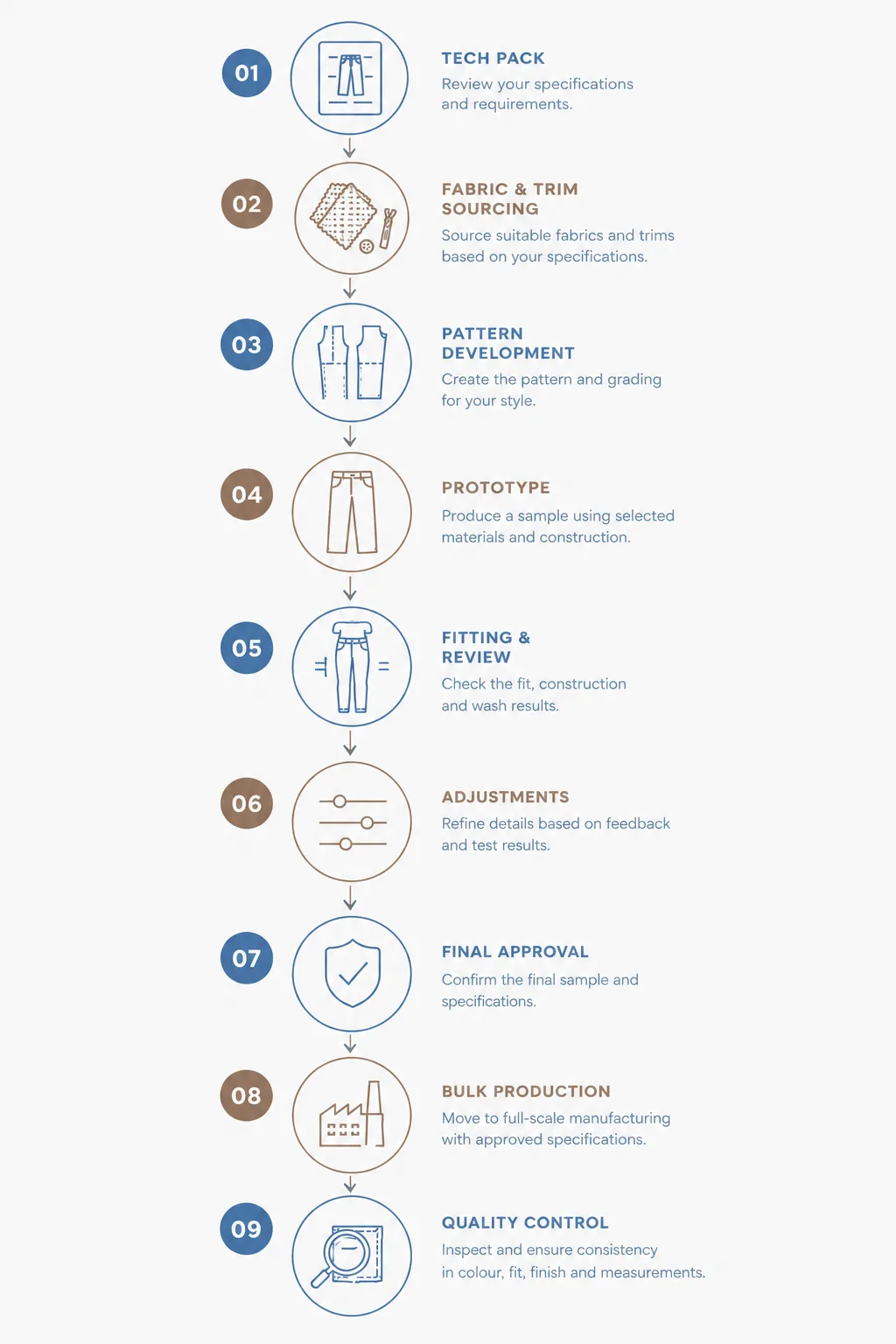
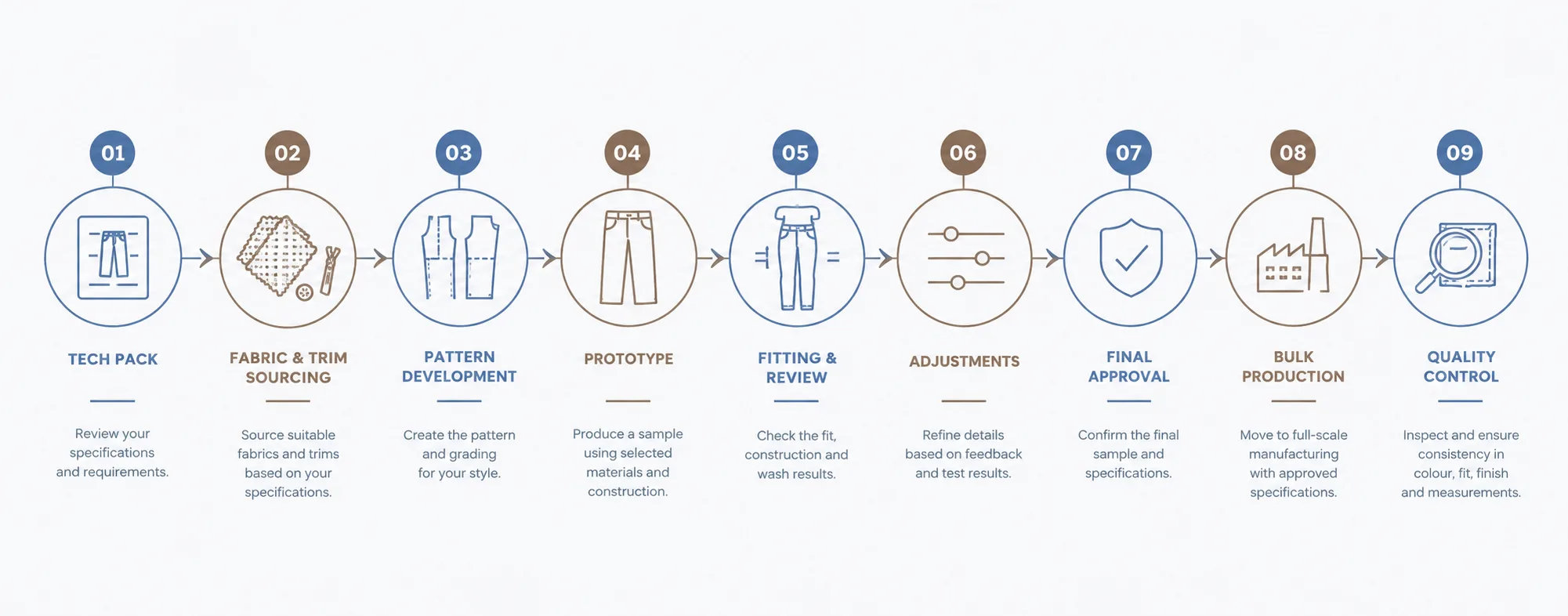
Trims are sourced at the same time as the bulk fabric. Custom trims have longer lead times, so brief them early.
Check the branding on the first sample, as well as fit and wash. The pre-production sample is made in the bulk fabric and trims. Denim sampling explained covers the rounds and what to check.
Some hardware is applied after washing. Labels go on in finishing. Quality control checks that hardware is attached properly. How jeans are made covers each stage.
How to fill in the hardware and trims section of your tech pack
List every trim once, with the same attributes, so the factory can source and quote it. The hardware and trims and the packaging and labelling sections of what is a denim tech pack show where each item goes.
For each trim, write:
- Component name and quantity per garment
- Material and finish, with a reference photo or supplier code if you have one
- Size: diameter for rivets and buttons, length for zips, dimensions for patches and labels
- Colour, including thread colour on labels and patches
- Placement on the flat drawing
- Artwork as vector files, with the method (engrave, emboss, deboss, print or woven)
- Stock or custom
- Attach before or after washing
- Care and content wording for each market
- Hangtag attachment and packaging requirements
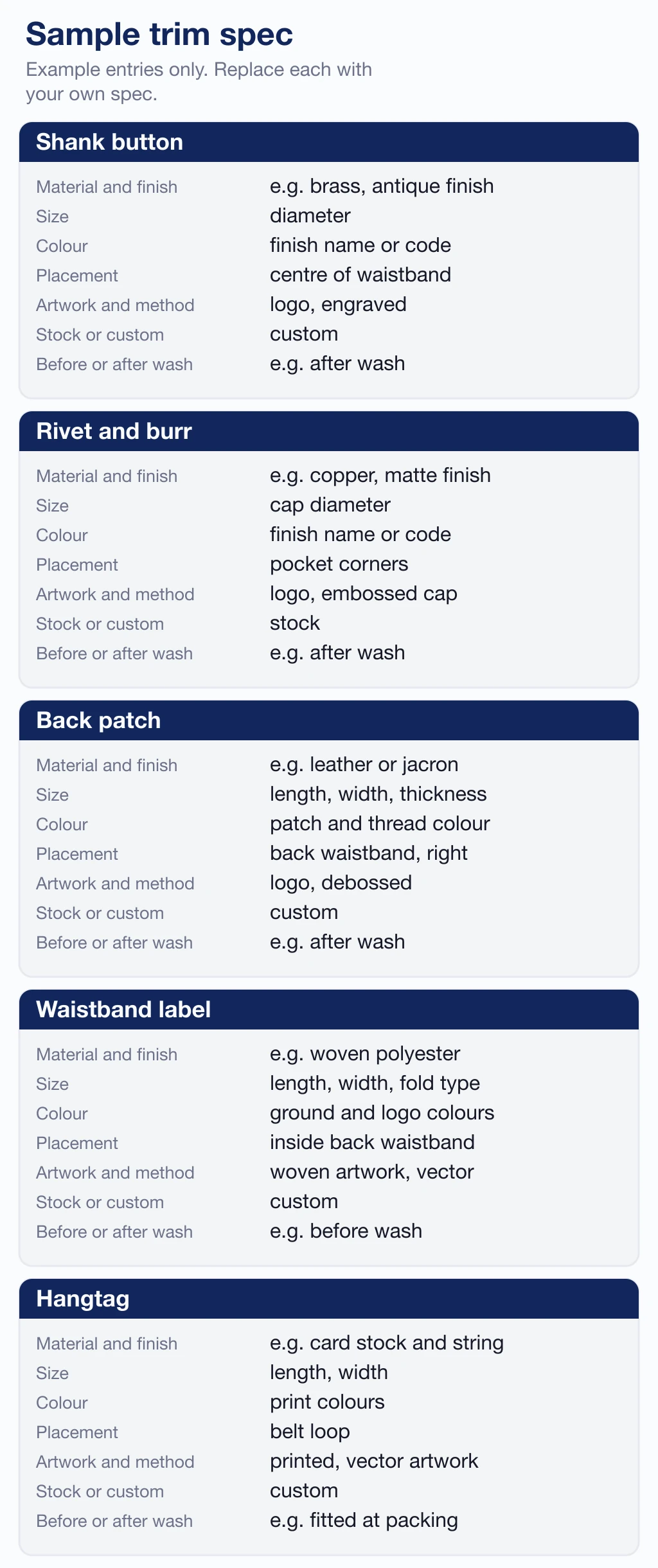
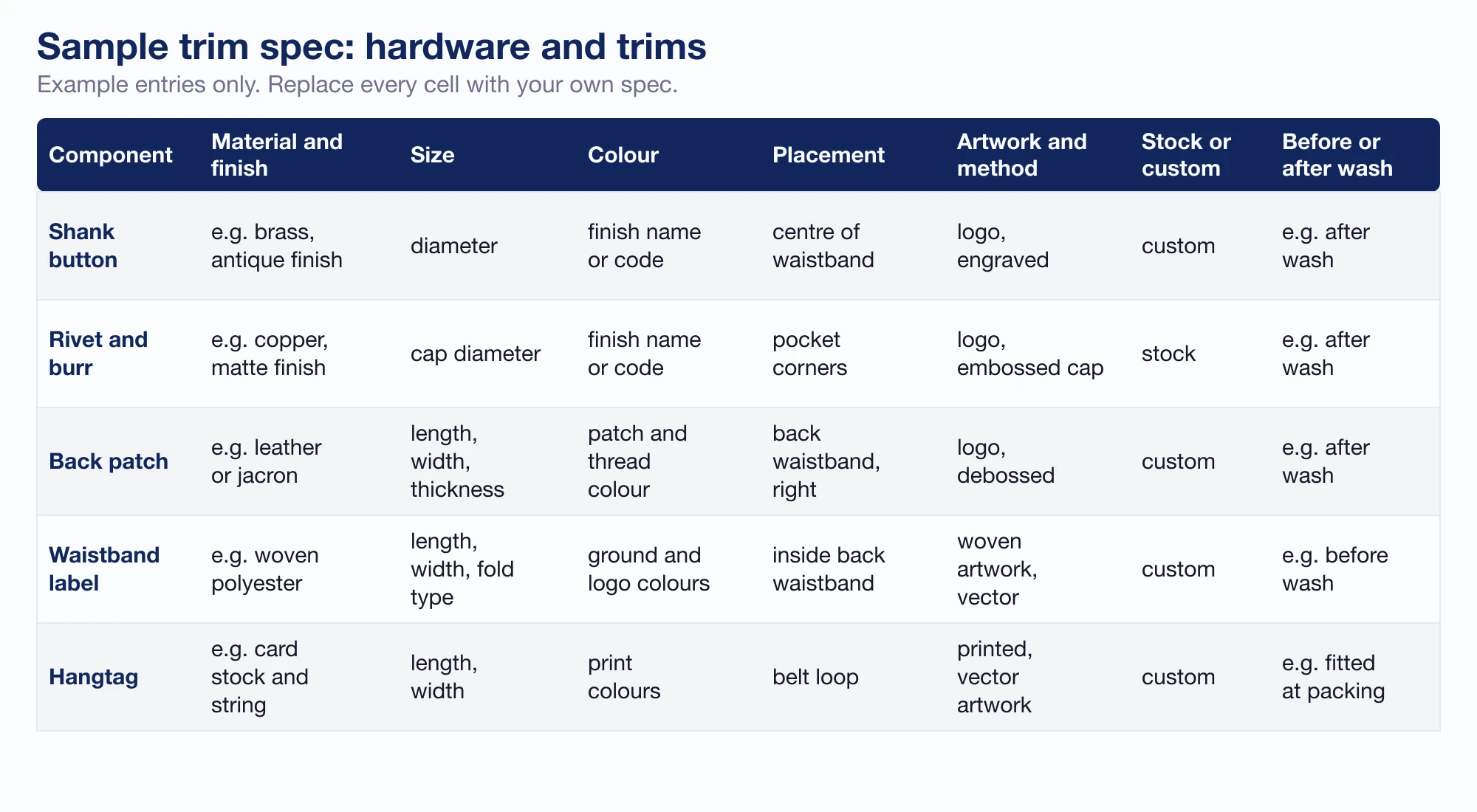
The table above shows a sample spec, with example entries only. Check every item on the sample before you approve bulk.
Jeans hardware and trims at Top Mondial
Top Mondial sources trims to your tech pack, alongside the bulk fabric, and applies them in sewing and finishing. Embroidery is done in house.
On OEM orders, we follow your trim spec. On ODM orders, you start from an existing style and change the trims and branding. For the two routes, read private label jeans manufacturing and OEM vs ODM denim manufacturing.
Our minimum order is 500 pieces. A sample typically takes around 7 days to develop and ship to you. Average bulk lead time is around 30 days. Custom trims can change that timing. We confirm it when you enquire.
We make jeans in three factories: one in Zhejiang, China, and two in Cambodia. The factories page shows the sites.
Send this with your enquiry:
- A tech pack or reference garment
- Your trim list, with artwork
- Quantities per style and colour
- Your target market, so we can plan the care labels