Guide
Garment sample types:
proto, fit, PP and TOP
Garment sample types are named rounds in production order: proto sample, fit sample, salesman sample (SMS), size set, PP sample, TOP sample and shipment sample. Each round answers a different question before you cut bulk.
This glossary covers what each type is for, who signs it, what fabric it uses, and what you risk if you skip it. Use it to plan sample rounds and a timeline with a factory, then start a project.
For the workflow, how many samples, and common mistakes, read denim sampling explained.
What garment sample types are (and are not)
Factories name garment sample types so each round has one job. In production order the seven names are proto (development sample), fit sample, salesman sample (SMS), size set, pre-production (PP) sample, top of production (TOP) sample and shipment sample.
This page is a glossary of those types: purpose, sign-off, fabric, and the risk of skipping. It is not a second walkthrough of the sampling process. For the workflow, how many rounds, and common mistakes, read denim sampling explained.
Each sample is checked against a written spec: the denim tech pack. How much of the first proto you invent, versus pick from a library, depends on OEM versus ODM.
1. Proto / development sample
The proto, or development sample, is the first physical garment from the spec.
It is often cut in a substitute fabric when bulk cloth is not in yet. You are checking pattern, construction and design intent, not the final wash or hand.
The brand and the factory development team sign it off together. A proto is not a fit approval.
2. Fit sample
A fit sample is made to check the pattern on a model or a form against the spec sheet.
Fabric is often still a substitute. You are judging fit, not bulk colour.
The brand's fit owner signs the comments. Until those comments are closed, do not treat the size as approved.
3. Salesman sample (SMS)
A salesman sample (SMS) is a selling sample for wholesale or retail buyers.
It should be closer to the bulk look than a proto: fabric, wash and trims nearer to production.
Brand sales or merchandising own this round. If you are not selling wholesale, you can often skip it.
4. Size set
A size set is the graded sizes after one size is approved.
It is made to check the grade rules, not only the sample size. Fabric may still be a substitute, or it may follow the approved proto fabric.
The brand and the factory pattern team sign the set off. A good sample size does not prove the rest of the range.
5. Pre-production (PP) sample
A pre-production (PP) sample is made from bulk fabric, trims and construction before the factory cuts bulk.
It is the last chance to lock the spec. What you approve here is what the line is meant to sew.
Brand production or QA signs with the factory. Skipping a PP on bulk fabric is how a substitute-fabric fit becomes a bulk surprise.
6. Top of production (TOP) sample
A top of production (TOP) sample is pulled from the start of the bulk line.
It confirms the line matches the PP: construction, wash, measurements and labels.
Brand QA or factory QC signs it. If the line is new or the wash is sensitive, do not skip TOP.
7. Shipment sample
A shipment sample is taken from packed goods before or at shipment.
Check packing, labelling and the carton. Do not reopen fit at this stage.
The brand or their inspector signs it. On a small order this is often folded into a third-party inspection.
How a fit sample is approved
A fit sample is approved on a fit model or a dress form, then measured against the spec sheet. Write comments as a point, a measurement, a direction and an amount. For example: front rise +1 cm.
Measurement tolerances belong on the spec. The factory cannot guess them. Put the measurement points in your denim tech pack.
On jeans, common fit issues are rise, seat, thigh and waist gape. Several fit rounds are normal. Do not treat the first fit sample as the last.
Why one approved size is not enough
Grading scales the approved size. A good 28/32 does not prove the 34 or the 36.
On a size set, check waist, seat, thigh and rise progression, plus pocket and fly placement and the hem. You are checking the grade rules, not only the sample size.
On a new block, put the grading table in your denim tech pack and check the size set before you cut the range.
Approve the wash with the fit, not after
Denim samples need a wash sign-off as well as a fit sign-off. Colour, hand and shrinkage change after wash. Approving a dry fit and leaving the wash until later is how bulk misses the sample.
Agree the wash on the same body you approved for fit, or on a wash standard tied to that fit. See custom denim washes for how a wash is specified, and denim shade variation for how bulk stays on shade.
Colour and hand on a dry proto do not survive the wash. Sign the wash on the fitted body before you lock the PP.
Samples you can combine or skip on a small first order
On a small first order you can combine some rounds. Others lock the spec. An ODM library style can shorten proto and fit because the base pattern already exists.

Often combined on a small first order
Simple styles, or a body from an ODM library, need fewer separate rounds.
often combined
- Proto and fit on one body when the style is simple or from an ODM library
- SMS skipped if you are not selling wholesale
- Shipment sample folded into a third-party inspection


the trade-off
- You save a round, but comments have to be written on the same garment
- An ODM base pattern can shorten proto and fit; a new OEM block cannot

Risky to skip
These rounds lock the spec. Skipping them moves the risk into bulk.
do not skip
- A true fit round on the brand's body, not only a proto on a substitute size
- A PP on bulk fabric, trims and construction before cutting
- TOP if the line is new or the wash is sensitive
if you skip
- Fit issues show up after the pattern is graded and the cloth is cut
- A substitute-fabric approval does not prove bulk hand, colour or shrinkage
- A new line or a sensitive wash can drift from the PP with no TOP check
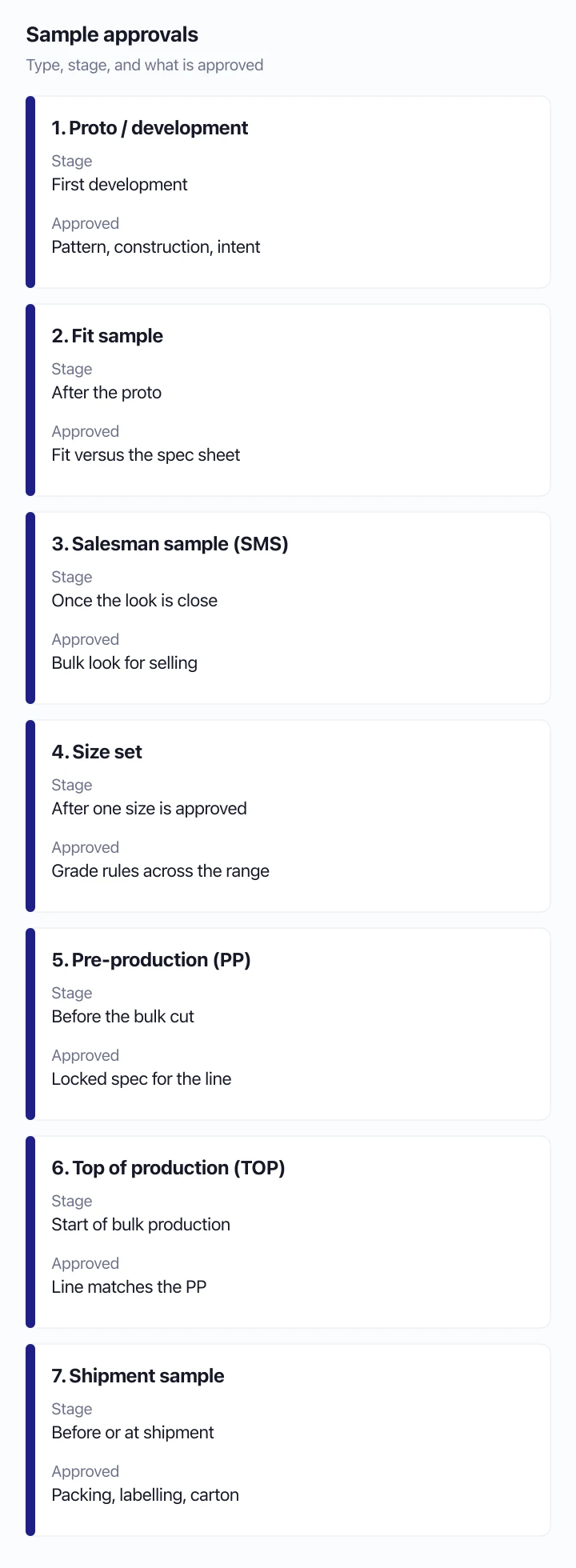
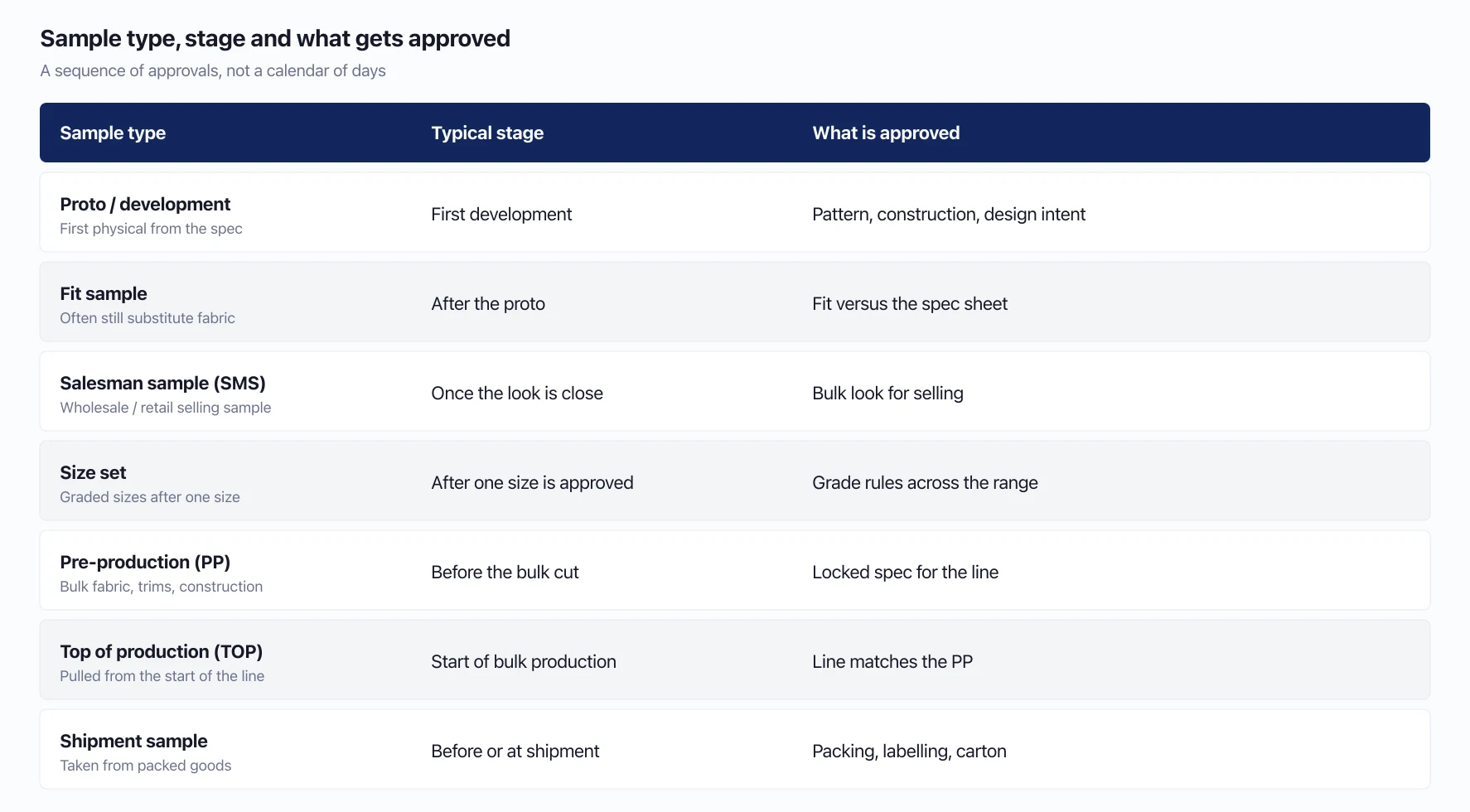
Sample type, stage and what gets approved
This is a sequence of approvals, not a promise of calendar days. Sampling at Top Mondial typically takes around 7 days to develop and ship. That figure varies with fabric and wash.
Sampling garment types with Top Mondial
Typical sampling is around 7 days to develop and ship; fabric and wash change that figure.
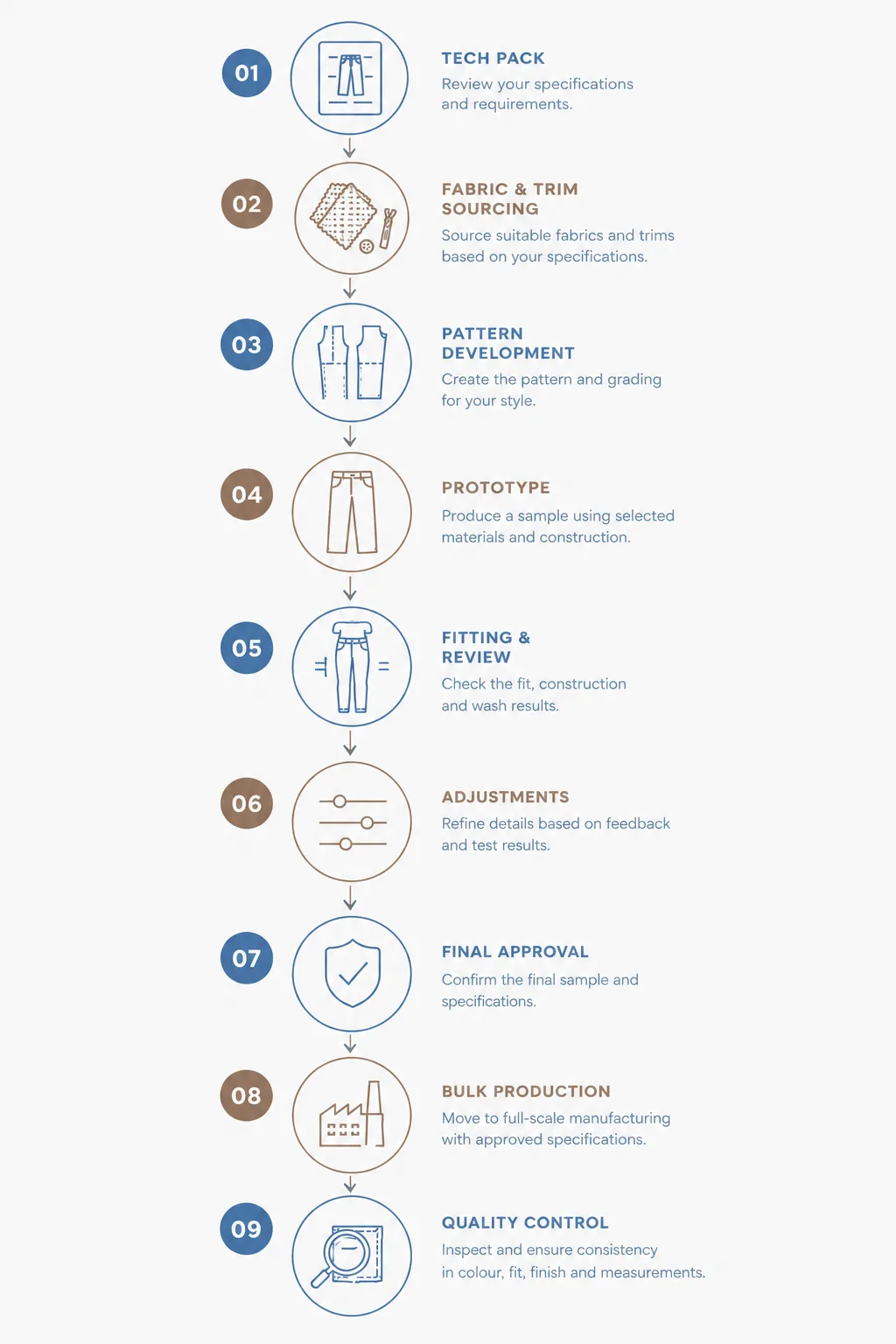
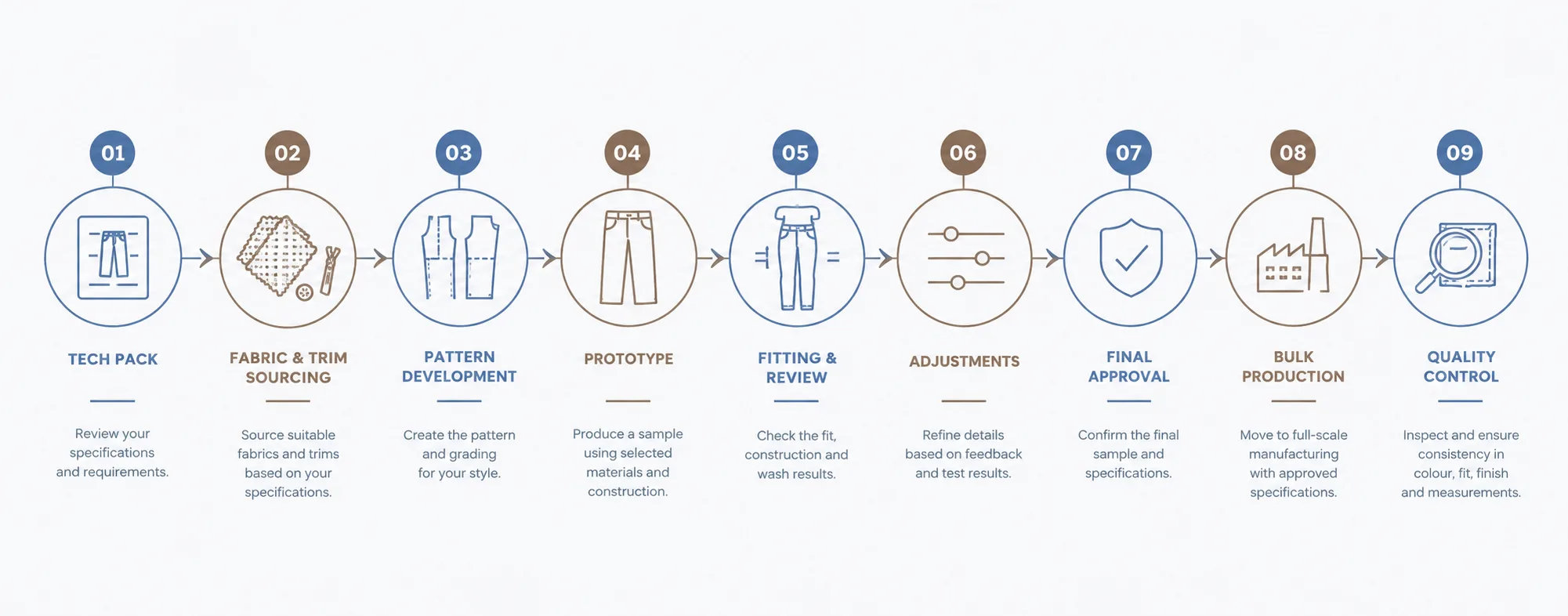
We have in-house design and wash development. The ODM library is around 1,000 styles a year, which can shorten fit development because the base pattern already exists.
For the sampling workflow itself, read denim sampling explained. For how much of the first proto you invent, see OEM versus ODM.