Guide
Denim shrinkage and stretch recovery:
what to test and what to put in your spec
Denim changes size and shape when it is washed and worn. Rigid denim shrinks, and stretch denim can grow and fail to spring back. Both show up as jeans that measure out of spec or bag at the knee.
This guide explains why denim shrinks, what sanforizing does, and how stretch denim recovers or fails. It also covers the tests a brand can ask for.
It ends with the shrinkage and stretch requirements to copy into your tech pack.
Why does denim shrink?
Do jeans shrink? Yes, most do to some extent. How much depends on the fibre, the weave and how the fabric was finished.
- Fibre: cotton fibres absorb water, swell, and relax as they dry. Rigid all-cotton denim is the most affected.
- Weave: yarns are held under tension on the loom. Washing releases that tension, so the fabric draws in. Length (warp) and width (weft) shrink by different amounts, so a spec gives both.
- Residual shrinkage: this is the shrinkage still left in the fabric as the mill delivers it. It is the figure a brand has to plan for.
- Heat: hot washing, and tumble drying especially, increases shrinkage.
Sanforized vs unsanforized (shrink-to-fit) denim
Sanforizing is a mechanical pre-shrinking finish applied at the mill. The fabric is compressed lengthwise over a moist, heated felt or rubber blanket, so most of the shrinkage happens before cutting. Unsanforized denim, also called shrink-to-fit or loomstate, skips this step and shrinks on the first soak. Selvedge describes the woven edge, not the finish, so selvedge denim can be either (see denim fabric weights explained).

Sanforized denim
Pre-shrunk at the mill. This is most commercial denim.
How it behaves
- A small residual shrinkage remains
- Sizing is more predictable
- It still needs testing after your wash


Best for
- Most fashion and core jeans
- Garment-washed styles

Unsanforized (shrink-to-fit) denim
Not pre-shrunk. It shrinks noticeably on the first wash and twists more.
How it behaves
- Large first-wash shrinkage
- Leg twist is more likely
- The fit changes after the first wash
Best for
- Raw and heritage styles, where the wearer soaks the jeans
- Brands that explain the shrinkage to customers on hang tags or the product page
Does sanforized denim still shrink?
Yes, a little. Sanforizing reduces shrinkage but does not remove it. A garment wash and home tumble drying can still shrink the jeans, so test after the intended wash.
Can raw denim be sold unwashed?
Yes. The customer then does the shrinking.
The size chart and care instructions must say whether the measurements are before or after the first soak.
How garment washing changes the final size of jeans
Most jeans are sewn from unwashed fabric and then garment-washed. The wash shrinks the garment again, on top of any residual shrinkage in the fabric.
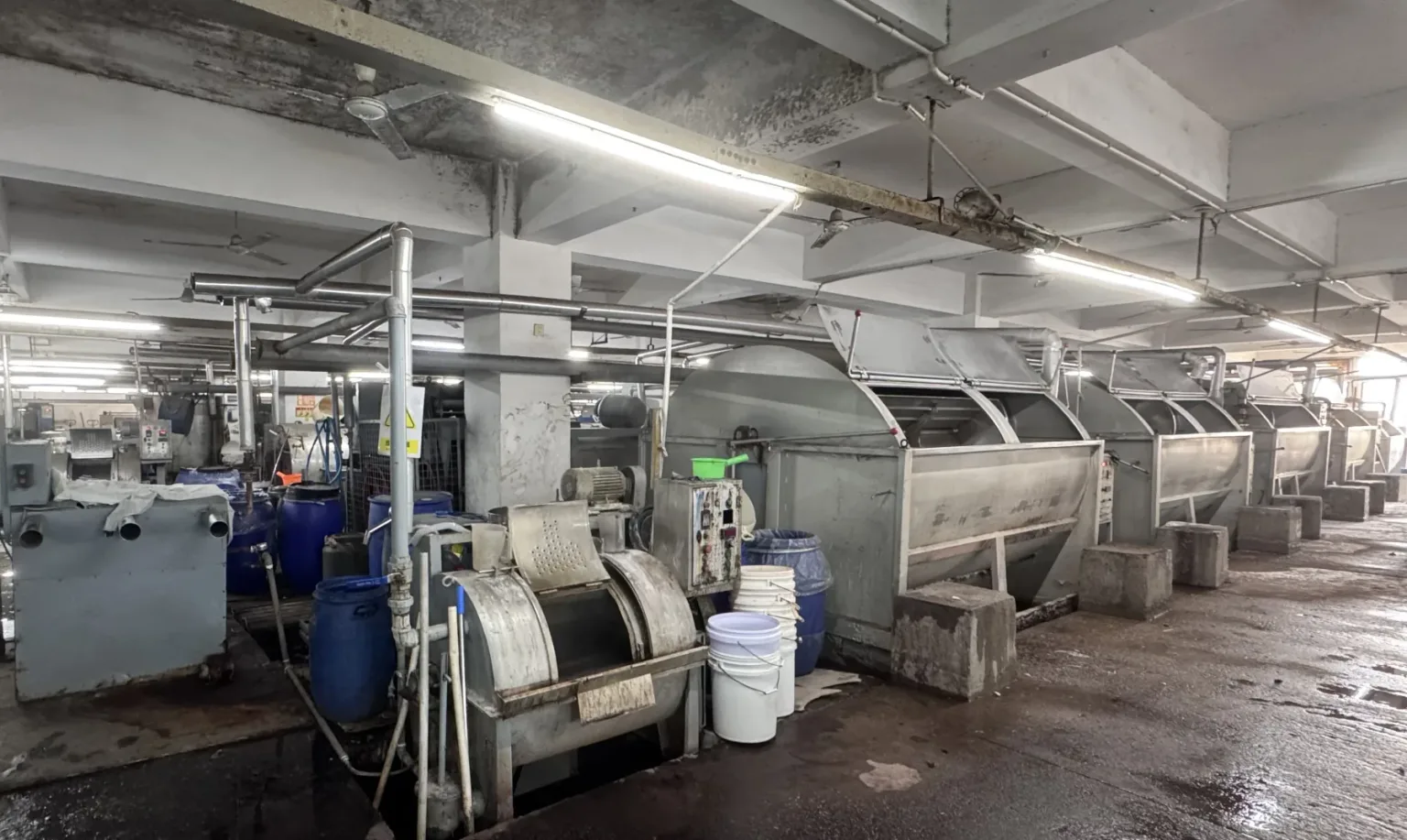
The amount depends on the wash recipe. A rinse shrinks differently from a stone or enzyme wash. Temperature, time, chemicals and drying all play a part. Custom denim washes explains what each wash does.
The same fabric with two different washes gives two different finished sizes. So a shrinkage figure belongs to a fabric-and-wash combination, not to the fabric alone.
That is why patterns are cut larger than the finished spec. The pattern grows by the measured shrinkage, with length and width handled separately.
Fabric lots also differ. The bulk lot is tested before cutting, and cutting is kept within a lot. How jeans are made shows where this sits in the process.
How shrinkage is built into the pattern
Four checks keep washed jeans measuring to spec.
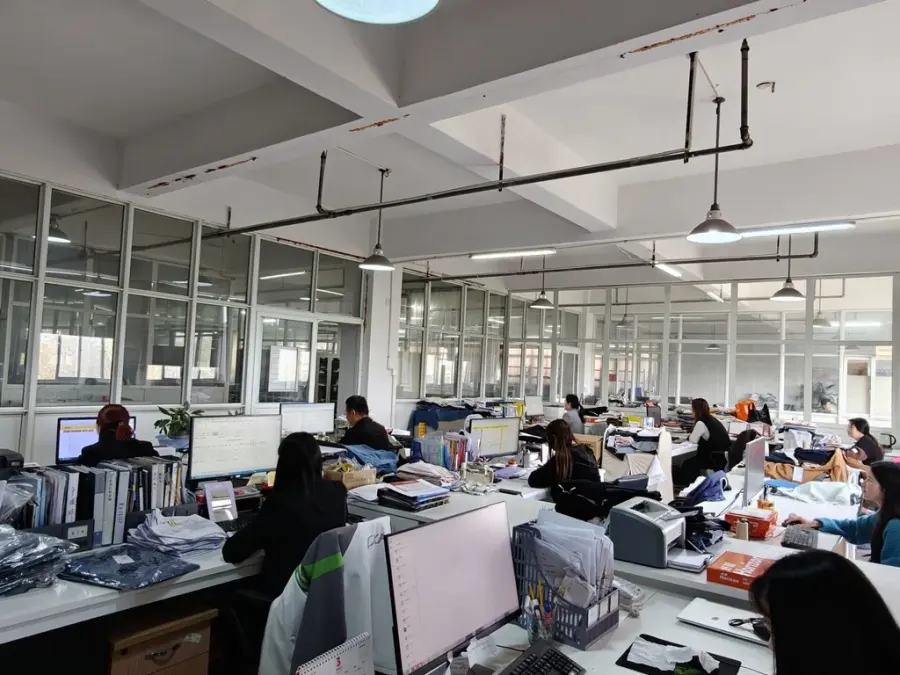
1. Test the fabric with your wash
Wash a marked fabric panel or a test garment with the intended wash. Measure the length and width before and after.
2. Adjust the pattern
Grow the pattern by the measured shrinkage in each direction. Then grade it across the sizes.
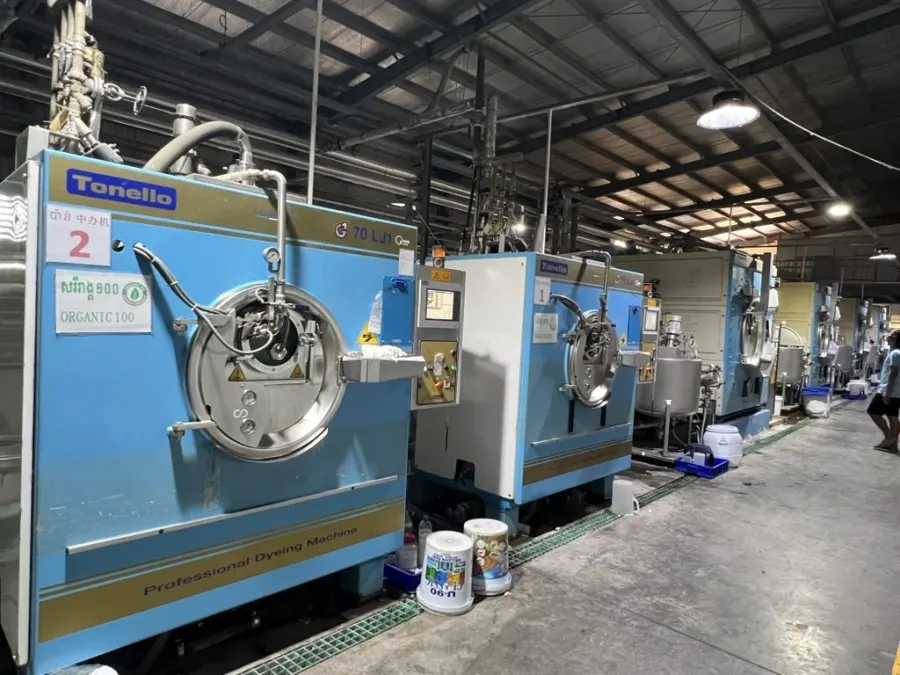
3. Wash and measure the sample
Measure the washed sample against the tech pack spec and its tolerances. Denim sampling explained shows how the approved sample is set.
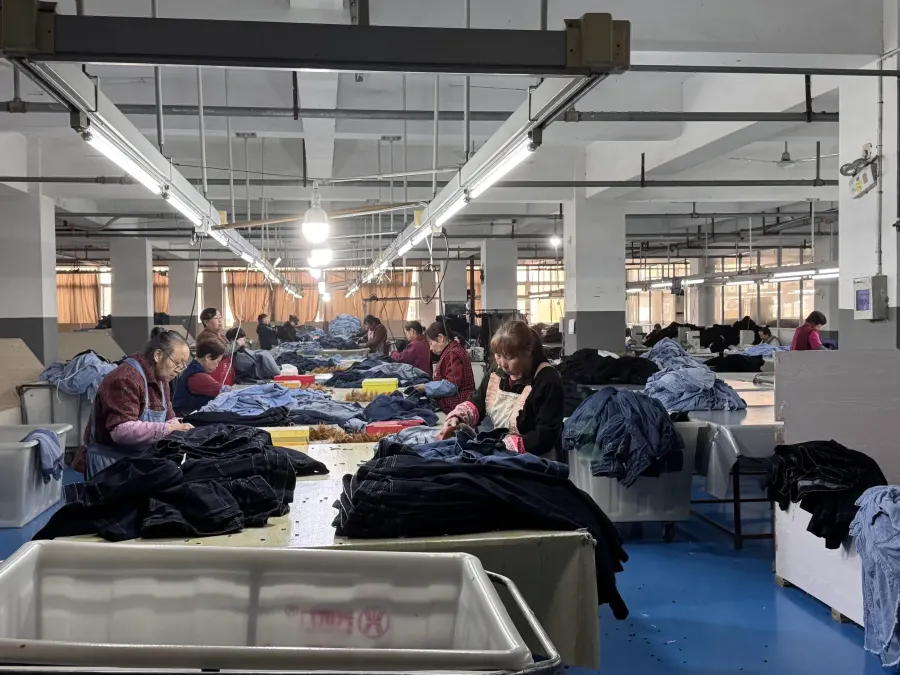
4. Check the bulk lot and the finished garments
Re-test the bulk fabric lot before cutting. Then measure finished garments against the tolerance table at inspection. See denim quality control and AQL inspection.
Stretch denim: elastane, growth and recovery
Stretch comes from elastane (spandex), usually wrapped in cotton as a core-spun yarn. The elastane percentage goes on the fabric spec.
Most stretch denim stretches across the width. This is weft stretch. Bi-stretch fabrics stretch in both directions.
Three terms describe how stretch fabric behaves:
- Stretch is how far the fabric extends under a set load.
- Recovery is how much of that extension it gives back when released.
- Growth is the permanent extension left over.
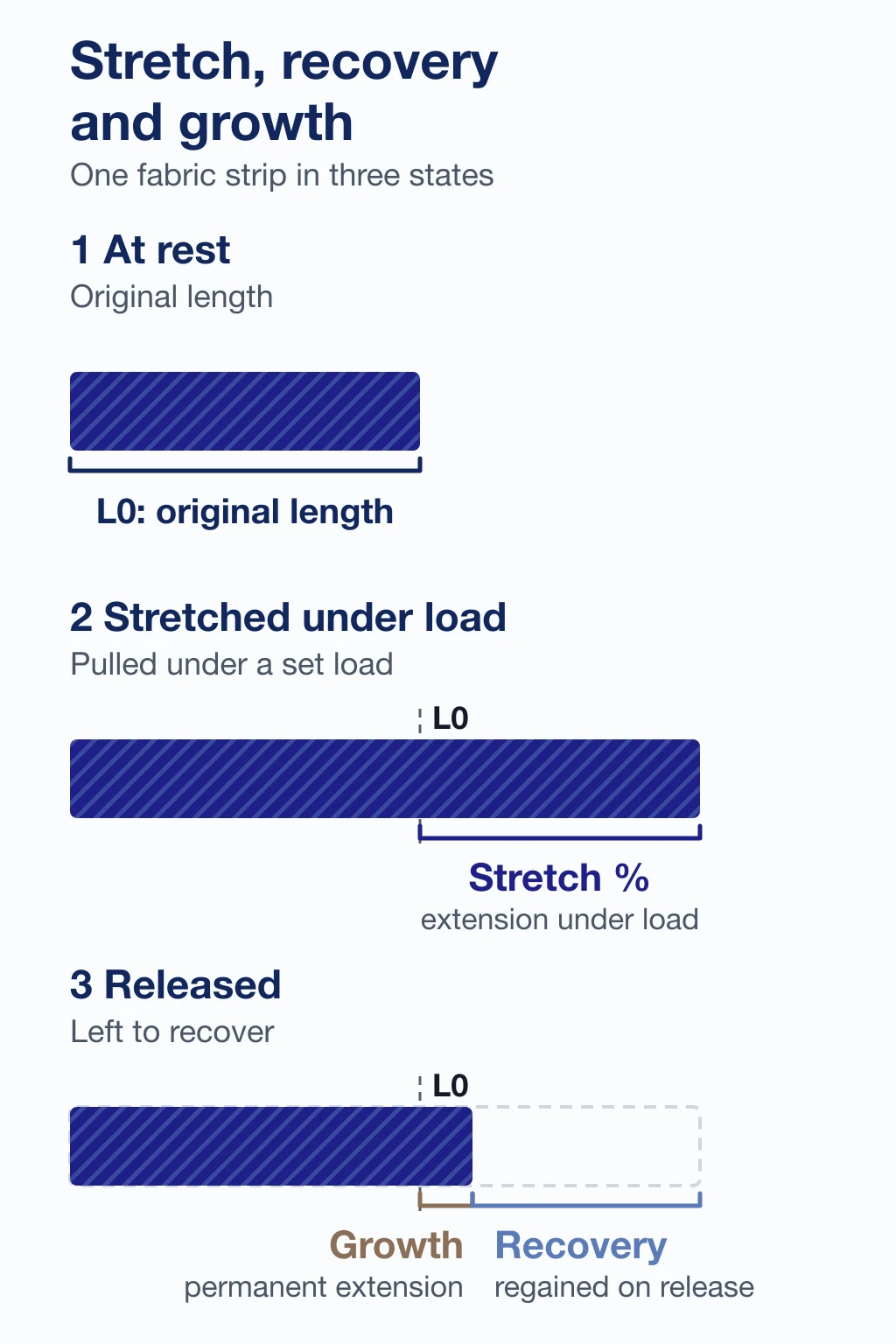
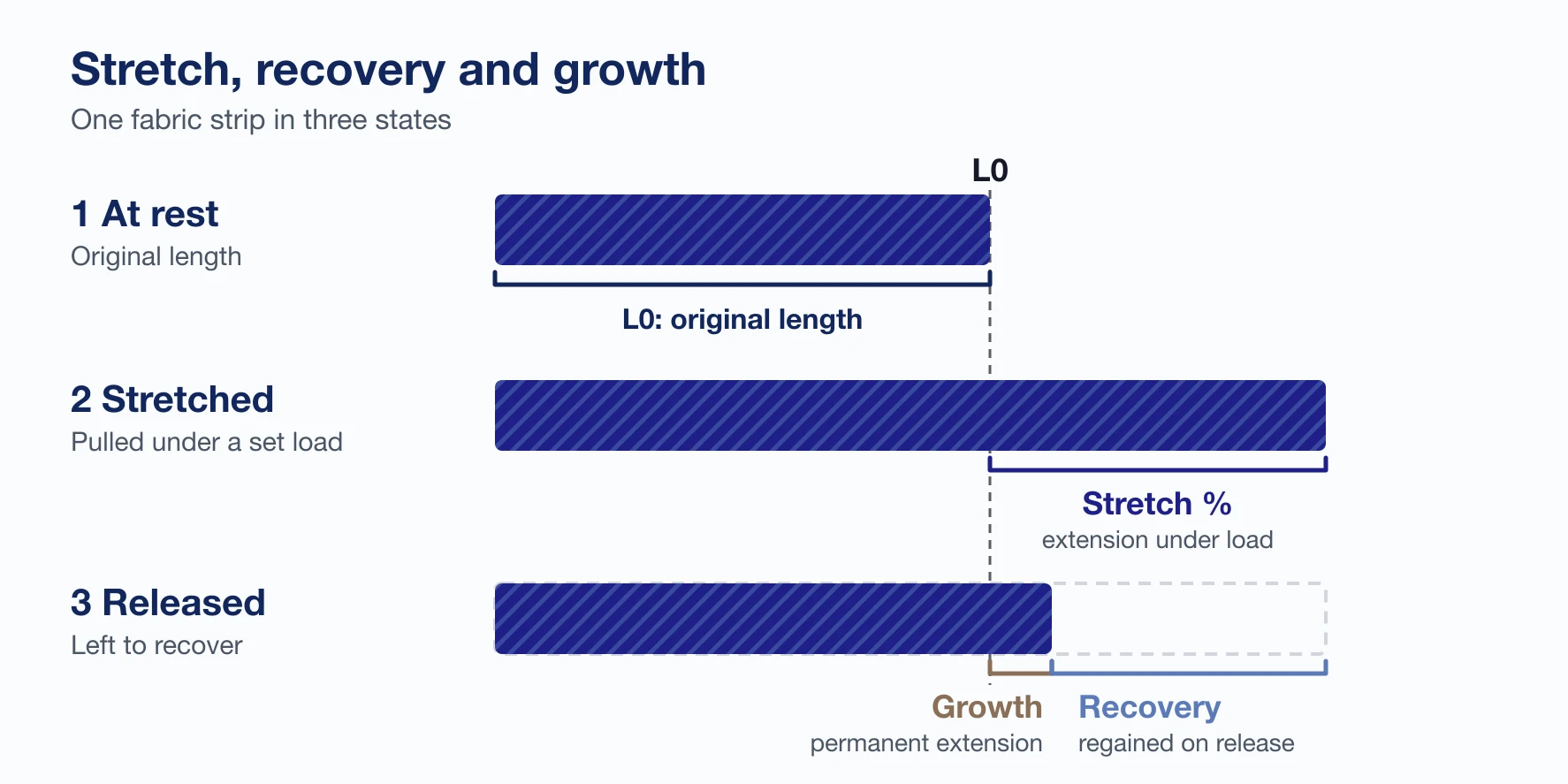
Good recovery and low growth keep jeans close to their original measurements after wear. This matters most on slim and skinny fits.
For the rigid, comfort-stretch and high-stretch categories, see denim fabric weights explained.
Why stretch jeans bag out: common failures
Most stretch problems show up after wear and washing, not on the new garment.
Bagging at the knees
Repeated bending stretches the fabric further than it can recover from. The usual causes are low recovery, high growth, or too little elastane for the fit.
Seat and waist growth
Jeans loosen through the day, and the waist measures bigger than spec. Check growth, not just stretch.
Recovery lost after washing
Harsh chemicals, heat, aggressive bleach and heavy abrasion can damage elastane. Test recovery on washed fabric, not only on the raw cloth.
Unexpected shrinkage in stretch fabric
Elastane fabrics can draw in more when the wash or drying is hot. Test shrinkage and recovery together, after the same wash.
Shrinkage and stretch tests a brand can require
A brand can ask for three tests.
- Dimensional stability after washing: mark measured lengths in both directions on a fabric panel or garment. Wash and dry it under a stated procedure, then re-measure. The result is the percentage change in length and width.
- Stretch (extension): pull a fabric strip with a set force and record how far it extends, as a percentage.
- Recovery and growth: hold the fabric stretched for a set time, then release it. Measure again after set intervals. That gives the percentage recovered and the permanent growth.
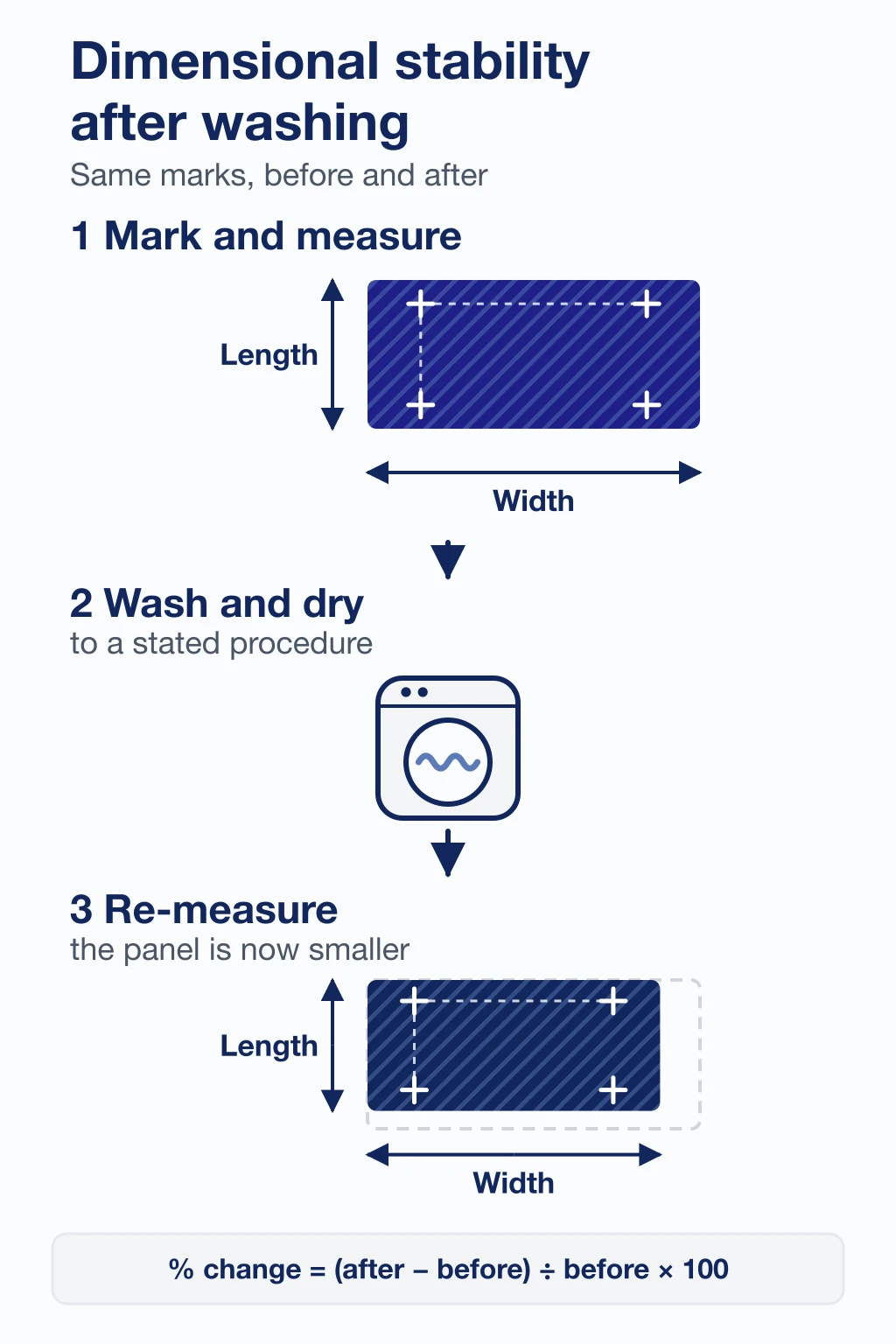
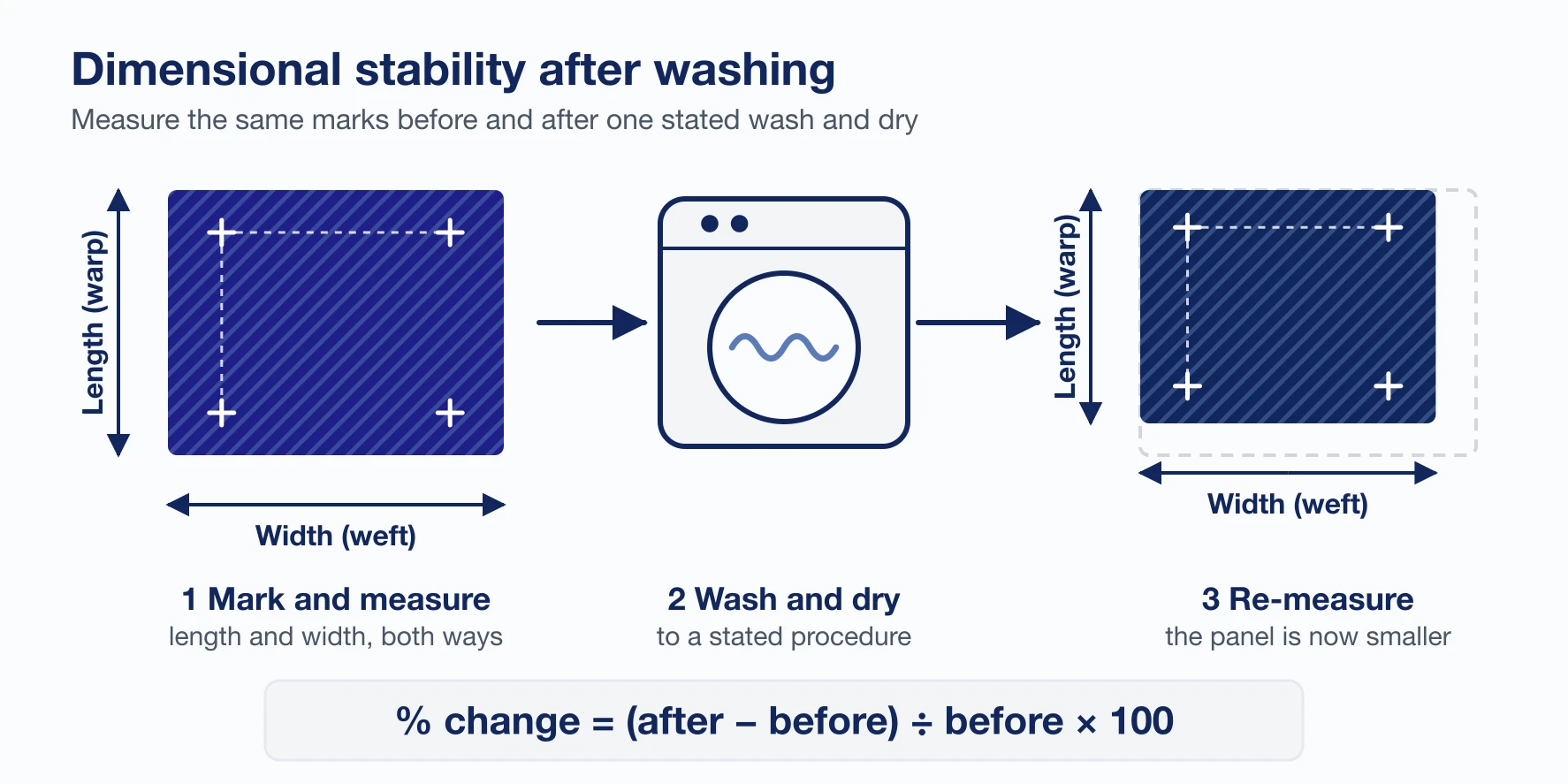
These tests are covered by AATCC and ISO method families. Your order names the method, the wash and dry conditions and the pass limits. For the full list of jeans tests, see the pre-shipment testing section of denim quality control and AQL inspection.
The wash conditions in the test should match the care label you will print. Otherwise the result does not predict what your customer will see.
Top Mondial does not publish general test data. Results come from the test report for each fabric or order.
Fabric test or garment test: which do you need?
The two tests answer different questions. Many brands ask for both.

Fabric test
Run on the fabric before cutting, by the mill, the factory or a lab.
It tells you
- The residual shrinkage of the lot
- The stretch and recovery of the cloth
- Whether the lot matches the approved fabric
Use it to
- Set the pattern allowance
- Accept or reject a bulk lot before cutting

Garment test
Run on a finished, washed garment.
It tells you
- Shrinkage after the garment wash and a home wash
- How seams, pockets and the waistband behave
- Whether finished measurements hold
Use it to
- Approve the sample
- Confirm bulk before shipment
How to write shrinkage and stretch requirements into a tech pack
Shrinkage and stretch requirements go in the fabric section and the measurement section of your tech pack. The diagram below shows where they are used. They are set at tech pack review, then checked again at sampling and at quality control.
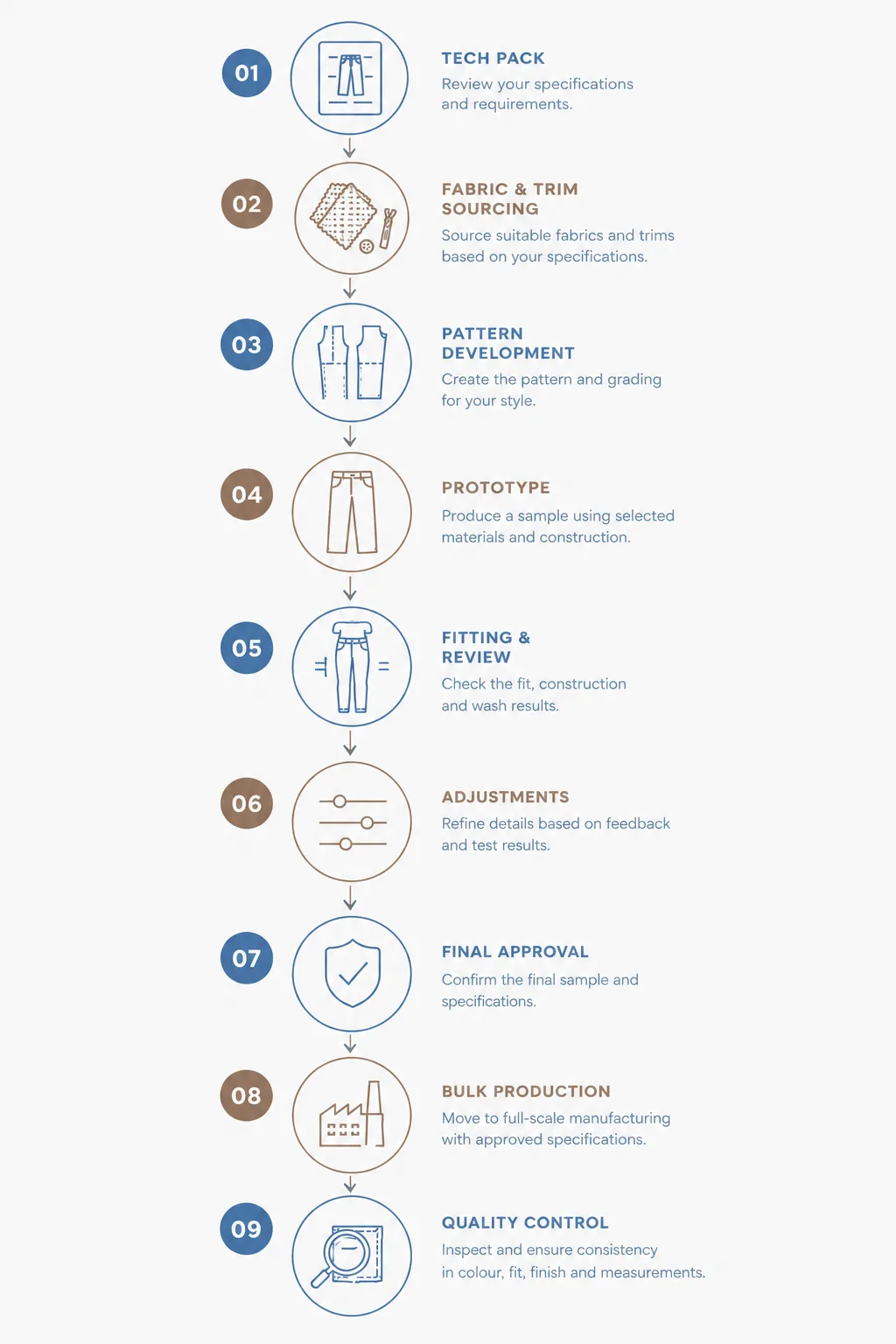
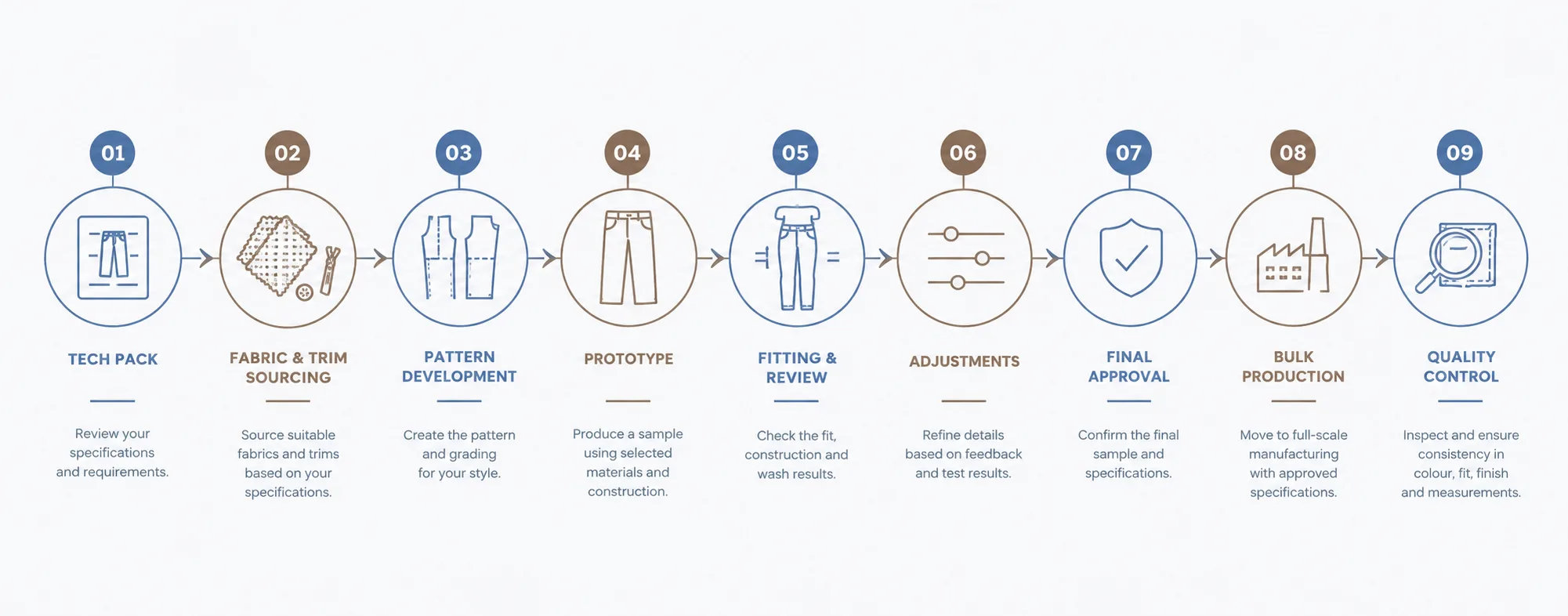
Copy this checklist into your tech pack:
- Composition, including the elastane percentage
- Sanforized or unsanforized
- Maximum shrinkage in length and width, after a named wash and dry procedure
- Test method family (AATCC or ISO) and who runs the test: the mill, the factory or an independent lab
- Stretch percentage, minimum recovery and maximum growth, for stretch fabrics
- Whether the spec measurements are before or after wash
- Measurement tolerances per point
- Re-test of each bulk fabric lot before cutting
- A test report per fabric and per order
You set the limits. A retailer's supplier manual often states them, so check it first. This guide gives no numeric limits, because they depend on the product, the fabric and your customer.
What if a fabric fails the shrinkage test?
There are four usual options:
- Re-test to confirm the result
- Adjust the pattern allowance for that lot
- Change the wash
- Replace the fabric
Agree in the order which option applies.
Should I specify measurements before or after wash?
After wash. Finished jeans are measured after wash, so the spec should be too. The factory works out the pattern allowance from the test.
Shrinkage and stretch testing at Top Mondial
Top Mondial has a fabric sourcing department and long-term partnerships with more than 20 fabric mills. In practice:
- Rigid, stretch, selvedge and performance blends are sourced
- Washes are developed in-house, so fabric and wash are approved together
- Patterns allow for wash shrinkage, with markers planned in CAD
- Fabric lots are checked before cutting, and cutting is kept within a lot
- Wash results are compared with the approved standard
Third-party inspection and compliance support is available. We make jeans in one factory in Zhejiang, China and two in Cambodia. The factories page shows the sites.
Shrinkage and stretch results are provided per fabric on request.
Send your tech pack with your shrinkage and stretch requirements, and we will confirm how each fabric will be tested.