Guide
Jeans manufacturer vs wholesaler:
which supplier fits your order?
Businesses that sell “wholesale jeans” or call themselves “jeans suppliers” may be factories, trading companies, wholesalers or sourcing agents. These are four different businesses.
Which one you buy from sets your price, how much you can customise, your minimum order, your timeline and who answers when something goes wrong.
Below: what each type is, how they compare side by side, how to tell which one you are dealing with, and when each route makes sense.
Factory, trading company, wholesaler or sourcing agent: what each one is
All four may call themselves jeans suppliers, but only one of them sews the jeans. The label tells you nothing; how a company produces does.
Factory (manufacturer)
A factory owns the cutting, sewing, washing and finishing lines. It makes jeans to order.
It works in one of two ways. With OEM, it makes your design. With ODM, it offers its own styles with your label on them.
Trading company
A trading company takes your order and places it with one or more factories that it does not own. It earns a margin, and handles paperwork and sometimes quality checks.
Wholesaler / distributor
A wholesaler buys finished jeans in volume and resells them from stock. They are sold in packs or cartons, under the maker's brand or unbranded.
You choose from what already exists. You are not ordering production.
Sourcing agent
A sourcing agent works for you, the buyer, not for the seller. The agent finds factories, negotiates and inspects, for a fee or a commission.
You still buy from a factory, through the agent.
How each supplier type changes price, MOQ and control
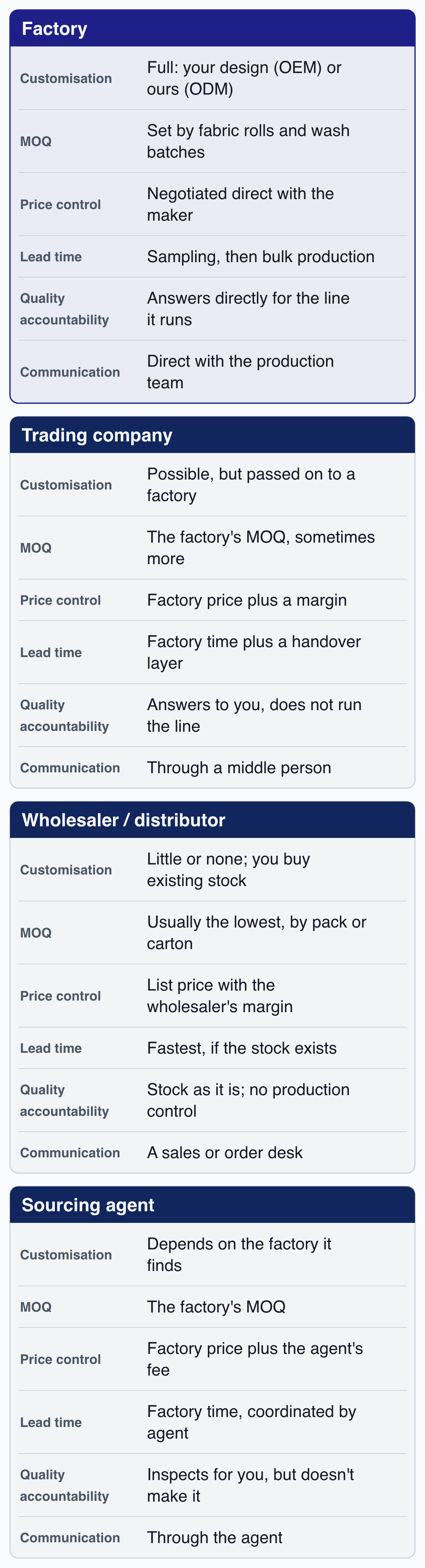
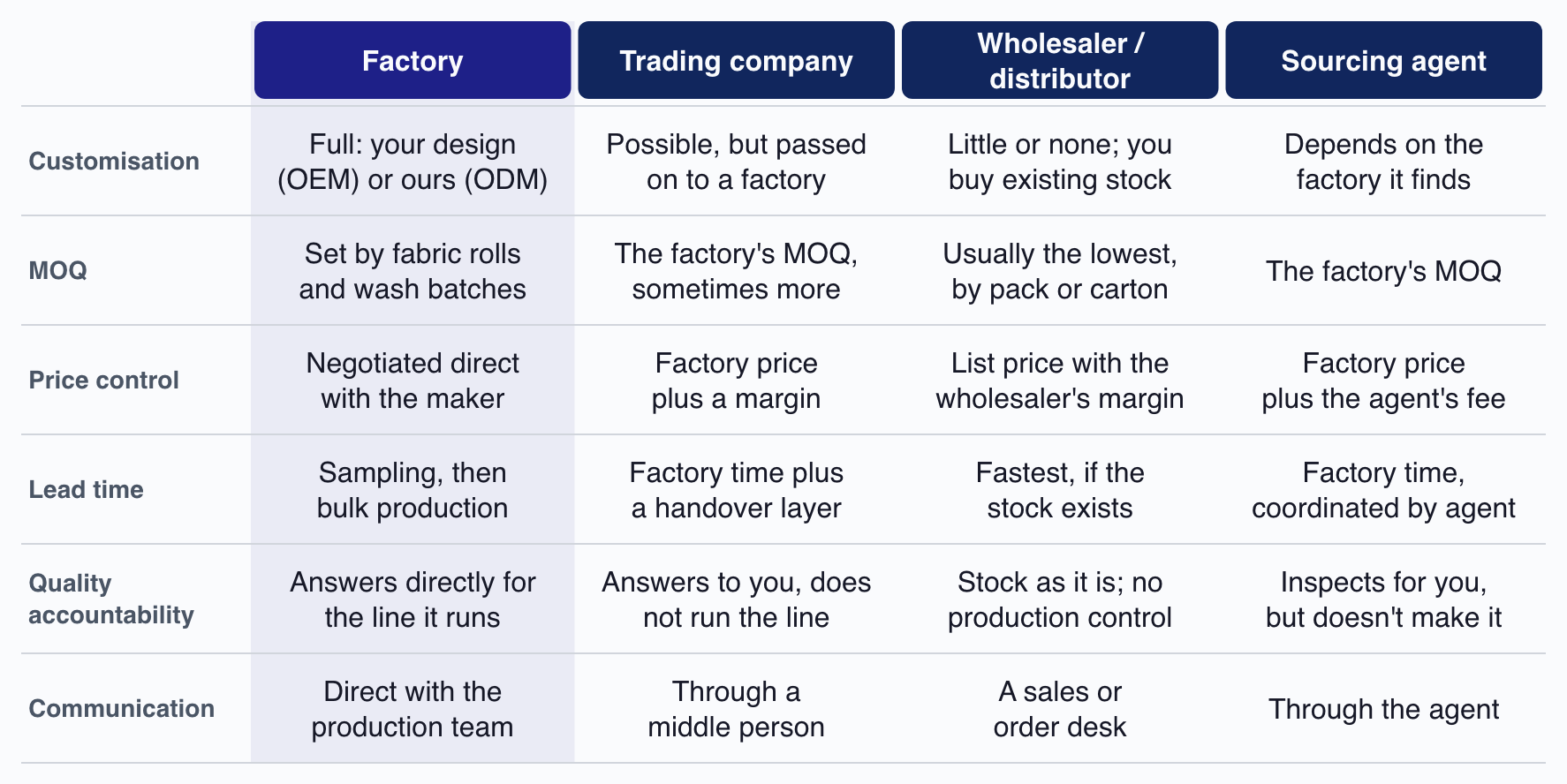
The table compares the four types on six factors. These are typical patterns, not rules, and individual businesses vary. The detail for each row follows.
Customisation
- Factory: full customisation. With OEM it makes your design. With ODM it adapts its own styles.
- Trading company: possible, but the request is passed on to a factory.
- Wholesaler: little or none. You buy existing stock.
- Sourcing agent: depends on the factory the agent finds.
MOQ
- Factory: set by fabric rolls, wash batches and line setup. Ask whether it applies per style or per colour. Top Mondial's MOQ is 500 pieces.
- Trading company: the factory's MOQ, sometimes with the trader's own minimum on top.
- Wholesaler: usually the lowest, by pack or carton.
- Sourcing agent: the factory's MOQ.
Price control
- Factory: you negotiate with the maker. Fabric, wash and quantity move the price directly.
- Trading company: typically the factory price plus a margin.
- Wholesaler: a list price with the wholesaler's margin built in.
- Sourcing agent: the factory price plus the agent's fee.
Lead time
- Factory: sampling, then bulk production.
- Trading company: the factory's time, plus a handover layer.
- Wholesaler: the fastest, if the stock exists.
- Sourcing agent: the factory's time, coordinated by the agent.
Quality accountability
- Factory: answers directly for the line it runs.
- Trading company: answers to you, but does not run the line.
- Wholesaler: you get the stock as it is, with no production control.
- Sourcing agent: inspects for you, but someone else makes the jeans.
Communication
- Factory: direct with the development and production team.
- Trading company: often through a middle person.
- Wholesaler: a sales or order desk.
- Sourcing agent: through the agent.
How to tell whether you are talking to a factory or a trading company
Trading company vs factory is hard to judge from a website. Many traders present themselves as factories, and some are listed as wholesale jeans manufacturers. These five checks show the difference.
- Own facilities: ask for the factory address, and for the building where your jeans will be sewn and washed. A factory names its own sites. A trader names “our partner factory” or stays vague.
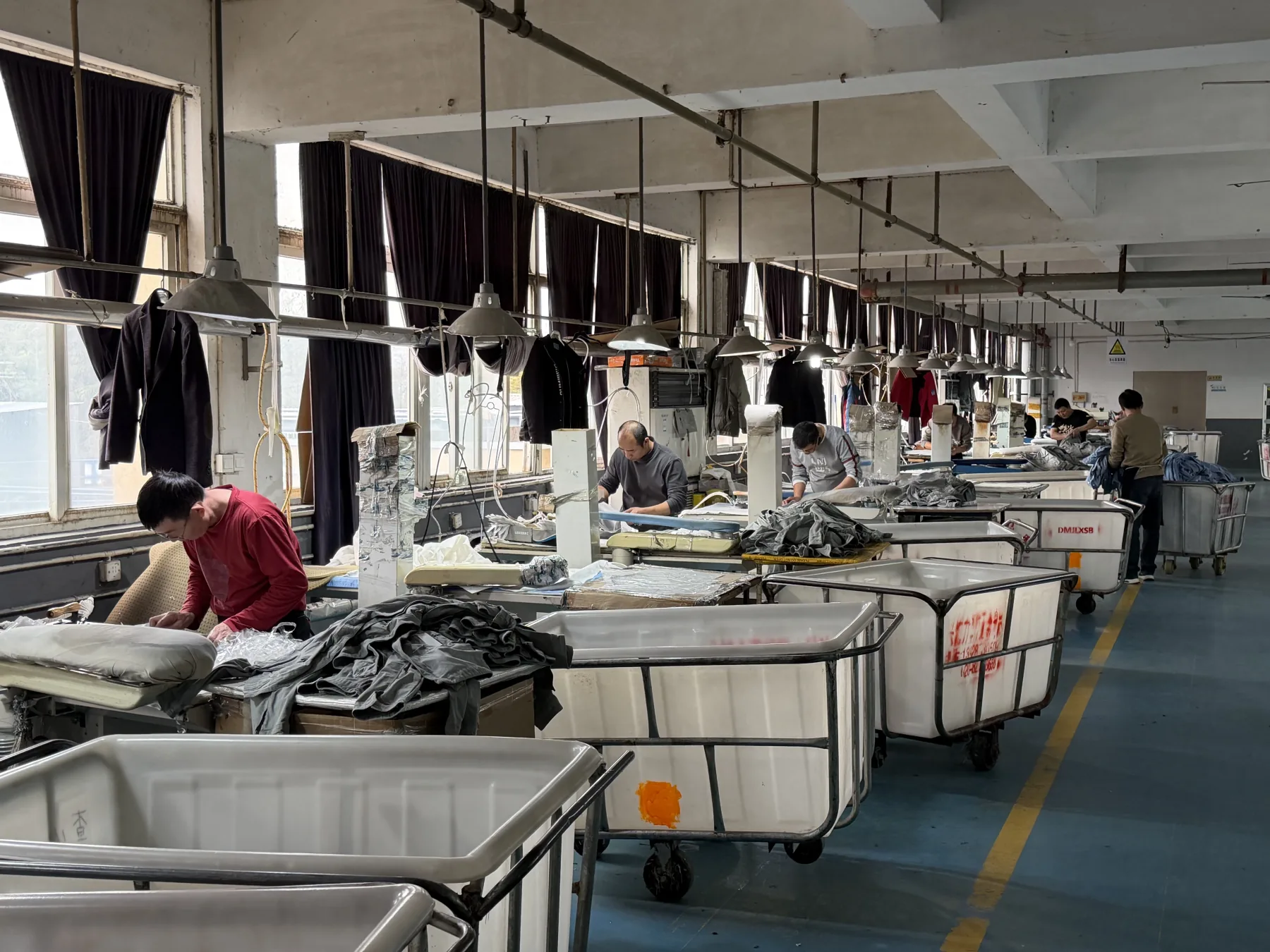
- Visible production: ask for a live video walk through the cutting, sewing and wash lines. Production photos should show the same site throughout.
- Certificates: check that the company named on ISO, BSCI and similar certificates is the same company that quotes and invoices you.
- Factory visit or showroom: a manufacturer can host you on site. A trader often meets you in an office or at a trade fair only.
- Technical answers: a factory's team answers questions on fabric, wash, shrinkage and sampling time directly. A middle layer has to “check and come back”.


For the full supplier checklist, read how to choose a denim manufacturer.
When buying from a wholesaler is the right call, and when a factory is
Neither route is better in general. It depends on your quantity, how much the product must be yours, and your timing. Small quantities, in the low hundreds or below, are often better served by a wholesaler or a smaller factory.

Buy from a wholesaler or distributor if:
You need stock, not production.
your order
- You need small or mixed quantities now
- You are happy with existing styles and unbranded or maker-branded goods
- You need goods on the shelf faster than a production cycle allows
what to expect
- The lowest minimums and immediate availability
- Higher unit prices than ordering from a factory
- Little control over fit, fabric or wash, and no exclusivity

Buy from a factory if:
You want jeans made for your brand.
your order
- You can meet a production MOQ per style
- You want your own label, fit, fabric or wash
- You plan repeat orders
what to expect
- A factory price with no middle margin
- Sampling and a production lead time
- Direct accountability for quality
When a trading company makes sense
A trading company can make sense if you are combining many categories or factories in one shipment. It can also help if you want one contact to handle several suppliers.
You pay a margin for that. Ask which factory will make your order.
When a sourcing agent makes sense
A sourcing agent makes sense if you have no team in the region and need someone to vet and inspect several factories.
Check how the agent is paid, and that a factory still makes your order.
Bulk and wholesale jeans orders from a factory: what is realistic
A bulk jeans order from a factory means ordering production in volume, direct from the maker. It is not picking from a warehouse of stock. Each order is cut, sewn and washed for you.
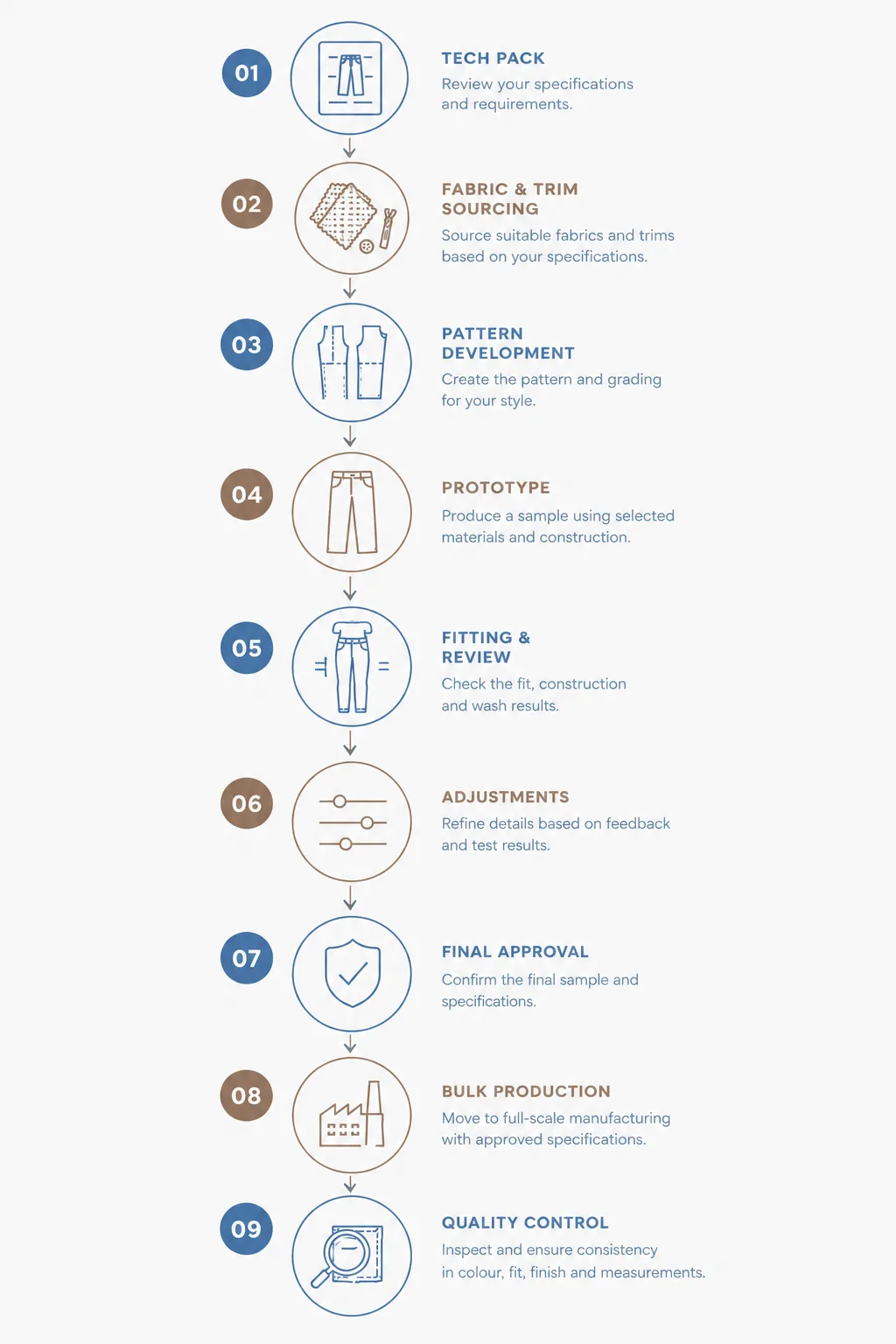
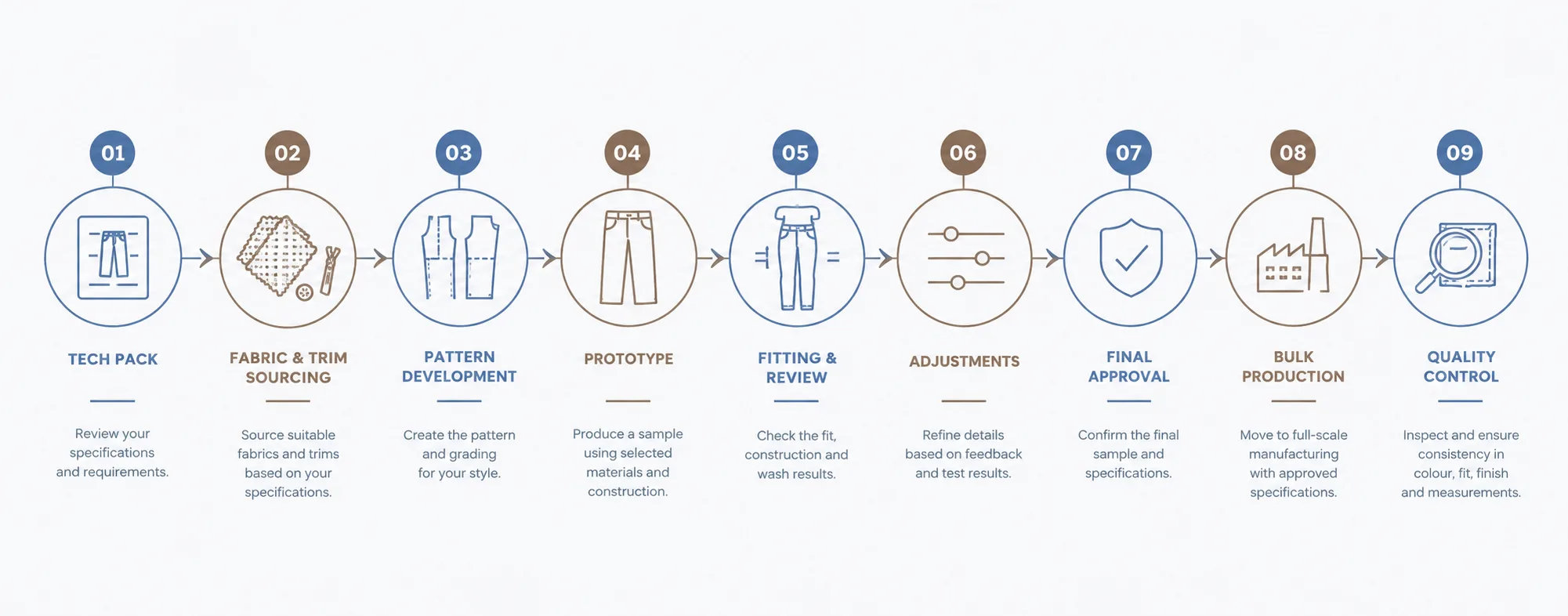
The diagram shows the path an order follows from tech pack review to quality control.
A factory's MOQ may apply per order or per style, so ask how it is counted. At Top Mondial it is 500 pieces. If your first order is smaller, read jeans manufacturer for startups.
Expect sampling before bulk. Sampling typically takes around 7 days to develop and ship. Our guide to denim sampling explained covers the steps.
The average bulk lead time is around 30 days. It depends on order size, complexity and materials.
Payment is staged around production. For new customers on FOB orders, Top Mondial typically works with a 30% deposit and a 70% balance before shipment. See payment terms explained.
How a wholesale order differs from OEM and ODM
In jeans wholesale, you buy finished goods that someone else designed and made, under the maker's brand or unbranded. No development is involved.
With OEM, the factory makes your design from your tech pack, so the product is yours. With ODM, you pick from the factory's own developed styles and put your label and branding on them. ODM is the closest factory equivalent to buying wholesale, and the usual route to private label jeans. Top Mondial's ODM collections add around 1,000 new styles a year. Browse our collections.
For the full comparison, read OEM vs ODM denim manufacturing.
Top Mondial: a jeans manufacturer, not a wholesaler
Top Mondial is a jeans manufacturer. We make everything in our own factories, one in Zhejiang, China, and two in Cambodia. We supply bulk and wholesale orders directly to fashion brands and retailers.
We offer both OEM and ODM. Our MOQ is 500 pieces.
The checks in this guide apply to us too. Our factories page shows the production sites, and buyers can visit our showroom. Our certificates include ISO 9001, ISO 14001 and BSCI.
If a factory is the right route for you, send us your quantity, target price and delivery window, with a tech pack or reference garment.